DGFT and Import Export Compliance in India: IEC, RCMC, SION, BIS, FSSAI, EPR, IGCR, SVB, AEO and Customs Approvals
Starting an import-export business or expanding international trade in India involves more than obtaining an Importer Exporter Code (IEC). Businesses must identify the applicable foreign trade policy requirements, customs procedures, product certifications, regulatory permissions, export documentation and tax-related obligations before moving goods across international borders.
An importer bringing electronics, food products, chemicals, machinery, medical products or packaged goods into India may require different approvals depending on the product classification, applicable regulations and import policy. Similarly, exporters may need RCMC registration, SION norms, export incentive documentation, IGST refunds and other trade-related registrations.
A missing certificate, incorrect HS code, incomplete declaration or unfulfilled compliance condition can result in customs queries, shipment delays, additional costs or difficulties in claiming eligible benefits.
This is why businesses need a coordinated approach to DGFT registration, customs compliance, import approvals and export documentation.
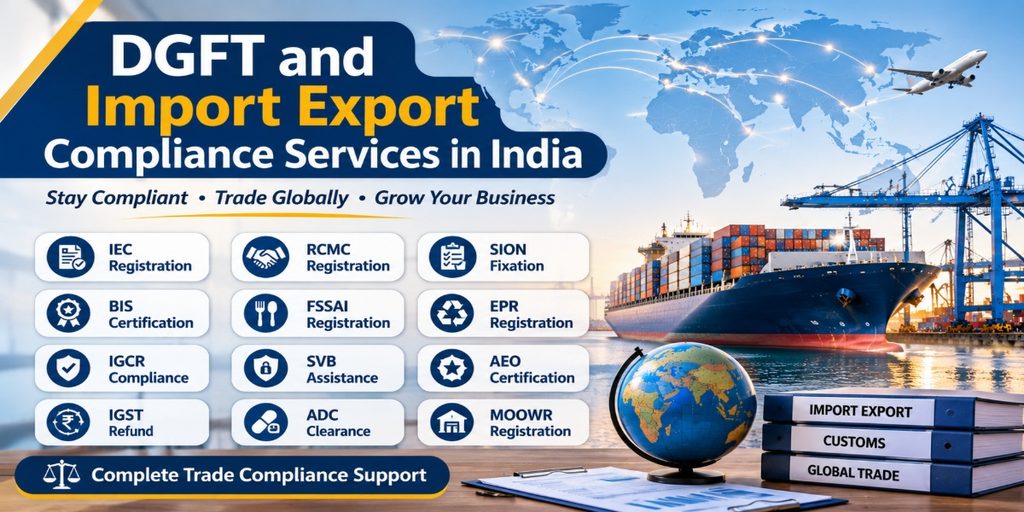
CargoMate Logistics supports importers, exporters and manufacturers with a range of trade compliance and logistics-related services, including DGFT procedures, BIS certification, FSSAI import clearance, EPR registration, IGCR compliance, SVB assistance, AEO certification, IGST refund, ADC clearance, MOOWR registration, SION fixation and RCMC registration.
DGFT Registration and IEC Compliance for Importers and Exporters
The Directorate General of Foreign Trade (DGFT), under the Ministry of Commerce and Industry, administers India’s Foreign Trade Policy and several import-export authorisation and registration processes.
An Importer Exporter Code (IEC) is a fundamental requirement for businesses undertaking most commercial imports and exports in India, subject to applicable exemptions.
What Does IEC Registration Involve?
IEC registration is associated with the business entity’s PAN and is obtained through the DGFT online system. Businesses should ensure that their IEC profile, business details, bank information and other applicable particulars remain accurate.
Important areas include:
- New IEC registration.
- IEC modification and correction.
- IEC profile management.
- Annual IEC updation, where required.
- Import and export policy verification.
- DGFT authorisation applications.
- Export scheme and registration-related compliance.
An inactive, suspended or incorrectly maintained IEC profile can create difficulties in import-export transactions and related procedures.
Businesses should also identify whether their products fall under free, restricted, prohibited or other specially regulated import-export categories.
RCMC Registration: Registration Cum Membership Certificate for Exporters
Registration Cum Membership Certificate (RCMC) is an important registration for exporters seeking recognition and benefits under applicable foreign trade policy provisions and export promotion frameworks.
RCMC is generally obtained from the relevant Export Promotion Council, Commodity Board or authorised organisation according to the exporter’s principal product category.
Who Needs RCMC Registration?
RCMC may be relevant for:
- Manufacturer exporters.
- Merchant exporters.
- Multi-product exporters.
- Businesses applying for certain DGFT authorisations or export benefits.
- Exporters seeking membership with an Export Promotion Council.
The appropriate registering authority depends on the product and applicable policy requirements. FIEO may be relevant where the product is not covered by a specific Export Promotion Council or in certain multi-product exporter situations.
Businesses should check the applicable RCMC validity, membership requirements and renewal or amendment procedures before making an authorisation application.
SION Fixation: Standard Input Output Norms for Export Benefits
Standard Input Output Norms (SION) specify the permissible quantity of inputs required to manufacture a defined export product under the relevant policy framework.
SION is particularly relevant for exporters using schemes such as Advance Authorisation, where eligible inputs may be imported subject to specified conditions and export obligations.
Why Is SION Important?
For manufacturers and exporters, correct input-output norms can help establish the eligible quantity of raw materials and inputs required for export production.
The process may involve:
- Identifying the export product and its classification.
- Reviewing the manufacturing process.
- Preparing the input consumption details.
- Establishing wastage and production requirements.
- Providing technical and supporting documentation.
- Submitting the applicable application for fixation or amendment.
Where standard norms are unavailable or unsuitable, businesses may need to examine the applicable ad hoc or self-declaration provisions, subject to the relevant scheme conditions.
SION fixation is not simply a general registration. It is a technical exercise that can affect the quantity of inputs permitted under an export authorisation.
BIS Certification for Imported Products in India
The Bureau of Indian Standards (BIS) develops and administers product standards and certification schemes in India.
Importers should verify whether their products are covered by a mandatory Quality Control Order (QCO), compulsory certification scheme or another applicable BIS requirement before placing an overseas order.
Which Products May Require BIS Certification?
Depending on the relevant notification, certification requirements may apply to products such as:
- Electrical and electronic products.
- Certain steel and metal products.
- Industrial equipment and components.
- Selected household products.
- Products covered under notified quality control orders.
The applicable certification route may depend on the product category, manufacturing location and relevant BIS scheme.
Why Should Importers Check BIS Before Shipping?
Importing a product without an applicable mandatory certification can create problems during customs clearance and subsequent sale in India.
Businesses should verify the product’s Indian Standard, applicable QCO, manufacturer eligibility, licence status and labelling requirements before shipment.
A foreign supplier’s general quality certificate should not be assumed to replace a mandatory BIS licence.
FSSAI Registration and Food Import Clearance
Businesses importing food products into India must examine the requirements under the Food Safety and Standards Act and applicable regulations.
FSSAI regulates food safety and imported food products through its licensing and import-clearance framework.
Common Food Import Categories
Food importers may deal in:
- Packaged and processed food.
- Food ingredients and additives.
- Nutraceuticals and health supplements.
- Edible oils.
- Beverages.
- Dairy and related products.
- Other regulated food commodities.
How Does FSSAI Food Import Clearance Work?
Imported food consignments may be referred by Customs to the FSSAI Food Import Clearance System (FICS).
Depending on the consignment and risk assessment, the process may involve document scrutiny, visual inspection, sampling and laboratory testing.
An importer should review:
- Valid IEC and applicable FSSAI import licence.
- Product classification and food category.
- Ingredient and composition details.
- Country of origin documentation.
- Certificate of Analysis, where applicable.
- Packaging and labelling requirements.
- Product-specific restrictions and approvals.
Food clearance should be planned before shipment because non-compliance can result in additional examination, delays or rejection.
EPR Registration for Importers, Producers and Manufacturers
Extended Producer Responsibility (EPR) is an environmental compliance framework that places specified responsibilities on covered producers, importers and other entities for managing waste generated from products or packaging.
Depending on the category, EPR obligations may arise under plastic packaging, e-waste, battery waste and other applicable waste-management rules.
Who May Require EPR Registration?
Entities potentially covered include:
- Producers.
- Importers.
- Manufacturers.
- Brand owners.
- Other entities specifically covered by the applicable rules.
Why Is EPR Important for Import Businesses?
An importer introducing regulated products or packaging into the Indian market may need to examine registration, reporting and applicable recycling or waste-management obligations.
The correct registration authority and compliance route depend on the product category and applicable rules. EPR registration is not a universal DGFT licence.
Businesses should identify the relevant category, applicable portal, registration requirements and ongoing compliance responsibilities before importing or selling regulated products.
IGCR Compliance: Import of Goods at Concessional Customs Duty
Import of Goods at Concessional Rate of Duty (IGCR) compliance is relevant to eligible importers claiming a concessional customs duty benefit for goods imported for specified purposes or end uses.
The framework is governed by the applicable customs rules and notifications.
What Does IGCR Compliance Involve?
Depending on the applicable exemption and rules, importers may need to:
- Verify eligibility for the customs duty exemption.
- Identify the prescribed end use.
- Maintain required records.
- Submit applicable declarations and information.
- Monitor utilisation of imported goods.
- Fulfil prescribed reporting and compliance conditions.
IGCR benefits should not be treated as automatic customs concessions. The importer must satisfy the conditions of the applicable notification and maintain evidence supporting the declared end use.
Incorrect end-use reporting or failure to fulfil prescribed conditions can create customs duty exposure and other compliance consequences.
SVB Registration and Related-Party Import Valuation
The Special Valuation Branch (SVB) is associated with customs valuation examination in specified related-party import transactions.
Where an importer purchases goods from an overseas related party, Customs may examine whether the relationship has influenced the declared transaction value.
When Can SVB Become Relevant?
SVB-related examination may arise in situations involving:
- Imports from a related overseas supplier.
- Transactions involving associated enterprises.
- Royalties and licence fees.
- Technical assistance or other payments.
- Additional payments connected with imported goods.
- Other circumstances relevant to customs valuation.
Importers should maintain agreements, invoices, transfer pricing information, payment details and other supporting records.
The objective is to establish whether the declared import value is acceptable under the applicable customs valuation provisions.
AEO Certification: Authorised Economic Operator Programme
The Authorised Economic Operator (AEO) programme is a customs facilitation framework intended to recognise eligible businesses involved in the international supply chain.
Eligible importers, exporters and other qualifying entities may apply under the applicable AEO category.
Potential Benefits of AEO Certification
Subject to the applicable category and conditions, AEO status may provide:
- Faster customs processing.
- Reduced examination frequency in eligible cases.
- Priority treatment in specified procedures.
- Improved supply-chain security recognition.
- Greater predictability in customs transactions.
Businesses should assess their compliance history, record-keeping systems, financial standing, security procedures and eligibility before applying.
AEO certification is particularly relevant to businesses with regular international trade activity and established internal compliance systems.
IGST Refund on Export of Goods
Exporters may be eligible for an Integrated Goods and Services Tax (IGST) refund where goods are exported on payment of IGST, subject to applicable GST and customs provisions.
The refund process involves coordination between GST records and Customs export data.
Common Reasons for IGST Refund Delays
- GSTIN mismatch.
- Incorrect invoice information.
- Shipping Bill errors.
- Missing Export General Manifest (EGM).
- Incorrect bank account information.
- Data transmission or validation issues.
- IEC suspension or alerts affecting processing.
Exporters should reconcile Shipping Bills, invoices, GST returns and EGM information to identify errors.
It is also important to distinguish between exports made on payment of IGST and exports made under LUT or bond without payment of IGST. These follow different refund mechanisms.
ADC Clearance for Regulated Imports
Certain imported products require approvals, permissions or no-objection certificates from the relevant regulatory authority before customs clearance.
In the pharmaceutical and related regulated-product context, importers may encounter requirements involving the Assistant Drug Controller (ADC) or other CDSCO-related procedures, depending on the product and applicable law.
Relevant product categories may include:
- Drugs and pharmaceutical products.
- Medical devices.
- Certain regulated healthcare products.
- Other products requiring specific regulatory permission.
Importers should identify the correct authority and applicable registration, licence, test or NOC requirements before dispatch.
The term ADC clearance should not be treated as a universal approval for every regulated product. The actual requirement depends on the product, import purpose and governing rules.
MOOWR Registration: Manufacturing and Other Operations in a Warehouse
The Manufacture and Other Operations in Warehouse Regulations (MOOWR) framework allows eligible businesses to undertake permitted manufacturing and other operations in a customs-bonded warehouse, subject to applicable conditions.
It can be relevant for manufacturers importing inputs, components and capital goods for production or other approved operations.
Why Do Businesses Consider MOOWR?
The framework may help eligible businesses manage customs duty liability on imported inputs and capital goods in accordance with the applicable warehousing provisions.
Important considerations include:
- Eligibility of the premises and operations.
- Warehouse licensing and customs permissions.
- Input and capital goods records.
- Manufacturing and other permitted operations.
- Movement and removal of goods.
- Record-keeping and compliance requirements.
- Duty implications when goods are cleared for domestic consumption or exported.
MOOWR should be evaluated against the business’s manufacturing model, export plans, domestic sales and working-capital requirements.
How These Registrations and Approvals Work Together
The services discussed above are connected through the import-export compliance process, but they do not all apply to every business.
For example:
| Business activity | Potential compliance requirement |
| Starting import-export operations | IEC and applicable DGFT compliance |
| Exporting specified products | RCMC and applicable export authorisation |
| Importing products covered by QCOs | BIS certification requirements |
| Importing food products | FSSAI licence and food import clearance |
| Importing covered electronic products or packaging | Applicable EPR registration |
| Claiming concessional customs duty | IGCR compliance |
| Importing from related overseas entities | SVB valuation examination, where applicable |
| Regular high-volume international trade | AEO eligibility assessment |
| Exporting goods on payment of IGST | IGST refund compliance |
| Importing regulated drugs or medical products | Applicable CDSCO/ADC permissions |
| Manufacturing in a bonded warehouse | MOOWR eligibility and registration |
| Applying for relevant export authorisations | SION and RCMC, where applicable |
A business should determine its requirements by reviewing the product’s HS code, country of origin, end use, import policy status, applicable notifications and business model.
Common Import-Export Compliance Mistakes Businesses Should Avoid
Regulatory compliance problems often begin before a shipment leaves the overseas supplier.
Some common mistakes include:
- Booking an import shipment without checking the applicable BIS or other product certification.
- Assuming an IEC alone is sufficient for every import.
- Ignoring food import licensing and FSSAI clearance requirements.
- Failing to examine EPR obligations for covered products.
- Claiming IGCR concessions without meeting end-use conditions.
- Providing incomplete related-party transaction information for SVB examination.
- Ignoring AEO eligibility and supply-chain security requirements.
- Making errors in Shipping Bill or GST invoice information that affect IGST refunds.
- Applying incorrect input-output norms under an export authorisation.
- Treating different regulatory approvals as interchangeable.
The most effective approach is to complete a product-wise and transaction-wise compliance review before shipment booking.
Why Choose CargoMate Logistics for DGFT and Import-Export Compliance?
Importers and exporters often need support across multiple authorities, registrations and customs procedures. Managing these requirements separately can create delays, inconsistent documentation and avoidable compliance gaps.
CargoMate Logistics assists businesses with a coordinated range of import-export compliance and trade facilitation services, including:
- DGFT and IEC registration support.
- RCMC registration.
- SION fixation assistance.
- BIS certification coordination.
- FSSAI registration and food import clearance support.
- EPR registration and compliance assistance.
- IGCR compliance.
- SVB assistance.
- AEO certification assistance.
- IGST refund coordination.
- ADC-related import clearance assistance.
- MOOWR registration support.
Whether you are a first-time importer, an established exporter, a manufacturer or a company expanding its international supply chain, the correct compliance planning can help reduce avoidable documentation issues and customs delays.
Get Import-Export Compliance Assistance from CargoMate Logistics
Contact our team to discuss your product category, import-export requirements, registrations and applicable customs procedures.
Frequently Asked Questions
1. What registrations are required to start an import-export business in India?
Most commercial importers and exporters require an IEC, subject to applicable exemptions. Depending on the product and business activity, additional licences, registrations and approvals may be necessary.
2. What is the difference between DGFT registration and Customs registration?
DGFT administers foreign trade policy and related authorisations, while Customs handles import and export clearance, assessment, duty collection and other border procedures. Businesses may need to comply with both systems.
3. Is BIS certification mandatory for all imported products?
No. BIS certification is mandatory for products covered by applicable compulsory certification requirements, including relevant Quality Control Orders. Importers should verify product-specific requirements before shipment.
4. Is FSSAI registration required for food imports into India?
Food importers generally need the applicable FSSAI import licence and must comply with food import clearance requirements. Consignments may undergo document checks, inspection, sampling and testing.
5. What is EPR registration for importers?
EPR registration is an environmental compliance requirement for entities covered by specific waste-management rules. Depending on the product, it may apply to importers, producers, manufacturers or other covered entities.
6. What is IGCR compliance in Customs?
IGCR compliance relates to claiming concessional customs duty on eligible imported goods for specified purposes or end uses. Importers must meet the conditions and documentation requirements of the applicable customs provisions.
7. What is SVB registration in import transactions?
SVB examination relates to customs valuation in specified related-party import transactions. Customs may examine whether the relationship between the buyer and seller has influenced the declared transaction value.
8. What are the benefits of AEO certification in India?
Eligible AEO-certified entities may receive customs facilitation benefits under the applicable category and conditions, including specified procedural advantages and supply-chain recognition.
9. What is the difference between IGST refund and Duty Drawback?
IGST refund concerns eligible GST paid on exported goods, while Duty Drawback provides eligible refunds of specified duties on exported products under the applicable drawback framework. The two have different eligibility and calculation rules.
10. What is MOOWR registration?
MOOWR relates to operating an eligible customs-bonded warehouse for permitted manufacturing and other operations under the applicable customs framework. It can be relevant to manufacturers using imported inputs and capital goods.
11. What is SION fixation in export business?
SION fixation establishes standard input-output norms for specified export products. It helps determine eligible input quantities under relevant export authorisation schemes, subject to applicable conditions.
12. Can one consultant assist with multiple import-export compliance requirements?
A trade compliance service provider can coordinate multiple registrations and procedures, subject to the relevant authority’s requirements and professional scope. Each approval must still be obtained from the competent regulatory authority.
Need Help with DGFT, Customs or Import-Export Compliance?
From IEC and RCMC registration to BIS, FSSAI, EPR, IGCR, SVB, AEO, IGST refund, ADC clearance, MOOWR and SION, CargoMate Logistics helps businesses coordinate their international trade compliance requirements.
Call +91 99108 47721 | Email info@cargomatelogistics.in | www.cargomatelogistics.in