Sea Freight from India: FCL, LCL, Costs & Shipping Process
For businesses importing raw materials, exporting finished products or moving commercial cargo internationally, sea freight offers a practical way to transport large volumes of goods across global markets.
However, choosing the right shipping method, understanding freight charges and preparing customs documentation can be challenging, especially for businesses managing international shipments for the first time.
CargoMate Logistics helps businesses navigate international freight requirements by coordinating shipping options, documentation and cargo movement according to their shipment needs.
Whether you need a full container or space for a smaller consignment, understanding your options can help you plan a more efficient shipment.
Planning an international shipment? Contact CargoMate Logistics to discuss your sea freight requirements and request a shipping quotation.
What Is Sea Freight from India?
Sea freight is the transportation of goods by cargo vessel between ports. It is widely used for international trade because it can accommodate a variety of cargo types, from consumer products and industrial materials to machinery and large commercial consignments.
Businesses use Sea Freight from India to export goods to international markets and import products from overseas suppliers.
Depending on shipment size, cargo characteristics and delivery requirements, the main options include Full Container Load (FCL), Less than Container Load (LCL), and specialised services such as breakbulk or out-of-gauge cargo transportation.
Sea freight can also be coordinated with road or rail transportation to move goods between the factory, port and final destination.
1. FCL vs LCL Shipping: What Is the Difference?
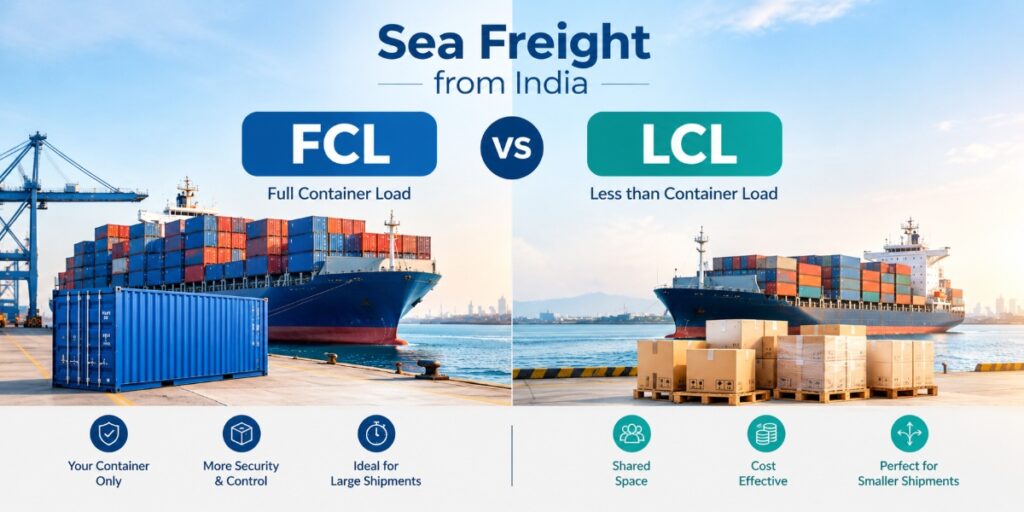
Choosing between FCL and LCL is one of the most important decisions when arranging ocean freight. The right option depends on cargo volume, handling requirements, budget and delivery schedule.
What Is FCL Shipping?
FCL stands for Full Container Load. Under this arrangement, a container is allocated to one shipper’s consignment, even if the cargo does not completely fill the container.
FCL is commonly used by manufacturers, wholesalers, exporters and importers shipping larger quantities of goods.
Benefits of FCL shipping:
- Exclusive use of the container for the shipment.
- Fewer consolidation and deconsolidation handling steps.
- Greater control over container loading and sealing.
- Potentially lower freight cost per unit for larger shipments.
- Suitable for many high-volume or handling-sensitive consignments.
FCL can be appropriate when cargo volume justifies the container cost or when minimising handling is a priority.
What Is LCL Shipping?
LCL stands for Less than Container Load. It allows multiple shippers to share container space, with each paying for their allocated cargo space and applicable service charges.
It is useful for smaller consignments that do not justify booking an entire container.
Benefits of LCL shipping:
- Lower initial shipping commitment for smaller shipments.
- No need to wait until you have enough cargo to fill a container.
- Useful for product samples, smaller commercial orders and trial shipments.
- Flexible options for businesses with irregular shipping volumes.
However, LCL shipments generally require consolidation at origin and deconsolidation at destination. These extra handling stages can increase transit time and create additional handling considerations.
FCL vs LCL: Quick Comparison
| Factor | FCL Shipping | LCL Shipping |
| Container space | Allocated to one shipper | Shared between shippers |
| Pricing basis | Usually per container | Often based on chargeable volume or weight, plus applicable fees |
| Best suited for | Larger consignments | Smaller consignments |
| Cargo handling | Generally fewer handling stages | Consolidation and separation required |
| Transit time | Often shorter for comparable routes | May take longer due to consolidation |
| Cost efficiency | Often improves with higher container utilisation | Often useful when cargo volume is low |
There is no universal volume threshold at which FCL always becomes cheaper. Compare the complete FCL and LCL quotations, including local charges, before making a decision.
2. How Much Does Sea Freight from India Cost?
The cost of sea freight depends on the shipment route, cargo dimensions, weight, shipping method and services required at origin and destination.
A quotation for the same cargo can vary between routes, carriers and departure dates.
Key factors affecting sea freight costs
1. Origin and destination: Freight rates differ according to port pair, service availability, routing and market demand.
2. Shipment volume and weight: FCL is generally quoted per container, while LCL charges are often calculated using cubic metres (CBM), chargeable weight or the provider’s applicable rating rules.
3. Container type: Standard containers, refrigerated containers and specialised equipment have different pricing structures.
4. Port and terminal charges: Origin and destination handling fees may be billed separately from the ocean freight rate.
5. Customs clearance and documentation: Customs broker fees, documentation charges, duties, taxes and inspection-related costs may apply.
6. Inland transportation: Collection from a factory, delivery to a port or final transport to a warehouse can add to the total cost.
7. Additional charges: Depending on the shipment, costs may include fuel-related surcharges, security charges, storage, demurrage, detention and special handling.
To compare quotations accurately, ask for a breakdown of ocean freight, origin charges, destination charges, customs services and inland delivery. Also confirm which services are excluded.
Need a Sea Freight Quote for Your Business?
Comparing ocean freight quotations can be difficult when one provider includes port handling while another lists it separately.
CargoMate Logistics can discuss your shipping requirements and help you evaluate suitable freight and logistics arrangements for your cargo.
Share your origin, destination, cargo dimensions, weight, shipment volume and preferred delivery schedule to help the team assess your requirements.
Contact CargoMate Logistics to request a sea freight quotation for your next international shipment.
3. The Sea Freight Shipping Process from India
A typical international sea freight shipment involves several stages. The exact process depends on whether you are importing or exporting, your chosen Incoterms and the services included in your agreement.
Step 1: Share Your Cargo Details
Provide the commodity description, number of packages, dimensions, gross weight, origin, destination and preferred shipment date.
This information helps determine whether FCL, LCL or another shipping method is appropriate.
Step 2: Select the Shipping Method and Confirm the Booking
Compare available services, vessel schedules, estimated transit times and total charges. Once the commercial terms are agreed, the shipment can be booked subject to carrier confirmation and equipment availability.
Step 3: Arrange Cargo Collection and Packing
Cargo may be collected from your premises or delivered to a warehouse or container freight station.
Packaging should be suitable for handling, stacking and the expected conditions during international transportation. Special cargo may require additional securing or protection.
Step 4: Complete Export Documentation and Customs Clearance
For exports from India, the required documentation and customs declarations must be prepared according to the commodity and applicable regulations.
The Shipping Bill, commercial invoice, packing list and other supporting documents may be required. Additional licences, certificates or declarations can apply to regulated products.
Step 5: Load the Cargo and Transport It by Sea
For FCL, the container is loaded and secured for the shipment. For LCL, cargo is consolidated with other consignments before the container is dispatched.
The vessel then transports the cargo to the destination port, subject to the carrier’s schedule and routing.
Step 6: Complete Destination Customs Clearance
The importer or appointed representative arranges the required import declarations, supporting documents, duties and taxes. Customs examination or additional regulatory checks may be necessary.
Step 7: Arrange Final Delivery
After the necessary release procedures, the cargo can be delivered to the buyer’s warehouse, distribution centre or project site, depending on the agreed scope of service.
Planning each stage early can help reduce avoidable delays and unexpected costs.
4. Documents Required for Sea Freight from India
Documentation requirements vary according to the shipment, commodity, destination country and whether the transaction is an import or export.
Common documents may include:
- Commercial Invoice: Describes the goods and their transaction value.
- Packing List: Identifies packages, quantities, weights and dimensions.
- Shipping Bill: Used for applicable export customs declarations in India.
- Bill of Lading: Provides evidence of the contract of carriage and serves other functions depending on its type.
- Certificate of Origin: May be needed to establish the origin of goods or support a preferential tariff claim.
- Import or Export Licences: Required for goods subject to relevant restrictions or regulatory controls.
- Insurance Documents: Relevant when cargo insurance is purchased.
- Product-Specific Certificates: May apply to regulated goods, depending on the product and destination.
Accurate product descriptions, classification, declared values and consistent information across documents are important. Errors can lead to customs queries, shipment delays or additional costs.
5. How to Choose the Right Sea Freight Forwarder
Selecting a reliable logistics partner involves more than comparing the lowest quoted rate.
Before choosing a provider, consider whether they can:
- Explain FCL and LCL options for your cargo.
- Provide a clear quotation with inclusions and exclusions.
- Coordinate shipping documentation and customs-related services.
- Explain estimated transit times and possible routing changes.
- Communicate shipment milestones and operational updates.
- Coordinate inland transportation when required.
- Identify cargo-specific handling or compliance requirements.
A good freight arrangement should match your cargo, commercial terms and delivery expectations rather than simply offer the lowest headline price.
CargoMate Logistics supports businesses looking to coordinate international shipping and cargo logistics. Discuss your shipment requirements with the team to determine which services may be suitable.
Frequently Asked Questions
Is sea freight cheaper than air freight?
Sea freight is often more economical for larger or heavier shipments, although the best option depends on cargo volume, route, urgency and the total landed cost. Air freight may be preferable for urgent, lightweight or high-value goods.
How long does sea freight from India take?
Transit time depends on the destination, port pair, carrier schedule, direct or transshipment routing, customs procedures and inland delivery. Confirm the estimated schedule for your specific shipment rather than relying on a generic timeline.
Is FCL better than LCL?
FCL can be suitable for larger shipments, dedicated container use and reduced handling. LCL can be more practical for smaller consignments. Compare the complete cost and transit implications before deciding.
What is CBM in sea freight?
CBM means cubic metre, a unit used to measure cargo volume. It is calculated by multiplying the length, width and height in metres for each package and adding the volumes together. LCL pricing may use CBM alongside other applicable rating rules.
Can I arrange door-to-door sea freight from India?
Door-to-door shipping may be available when origin collection, ocean transportation, destination handling, customs arrangements and final delivery are coordinated under the agreed service scope. Confirm the exact inclusions, responsibilities and exclusions before booking.
Conclusion: Plan Your Next Sea Freight Shipment with CargoMate Logistics
Sea freight from India can support businesses moving goods to international markets, provided the shipping method, costs, documentation and delivery arrangements are planned carefully.
FCL is often suitable for larger consignments, while LCL offers a flexible option for smaller shipments. Understanding freight charges, customs requirements and the complete shipping process helps businesses make more informed decisions.
Whether you are exporting commercial products, importing materials or arranging regular international shipments, CargoMate Logistics can discuss the freight coordination and logistics services relevant to your requirements.
Ready to ship internationally? Contact CargoMate Logistics to discuss your cargo, compare suitable shipping options and plan your next sea freight movement.