India to South America Freight Forwarder: How to Choose the Right Logistics Partner
Shipping goods from India to South America involves more than simply booking ocean or air freight. Businesses need to manage international routes, documentation, customs requirements, cargo handling, transit times, destination delivery and unexpected logistics challenges.
Choosing the right India to South America freight forwarder can help businesses coordinate these moving parts through a single logistics partner.
Whether you are exporting machinery, industrial equipment, textiles, pharmaceuticals, auto components, consumer products or commercial cargo, the right freight forwarding company (Cargomate logistics) can make international shipping more structured and predictable.
Why Choosing the Right Freight Forwarder Matters
India–South America trade involves long-distance transportation and multiple logistics stages. Depending on the destination, cargo may move through several ports, carriers, customs processes and inland transportation networks.
A capable freight forwarder can coordinate:
- Cargo pickup from the supplier or factory
- Export documentation
- Freight booking
- Air or ocean transportation
- Port handling
- Customs coordination
- Cargo tracking
- Destination logistics
- Final delivery
Instead of managing different providers for each stage, businesses can work with one logistics partner for better coordination.
Looking for an India to South America freight forwarding partner? Connect with CargoMate Logistics to discuss your shipment requirements and freight options.
What Does an India to South America Freight Forwarder Do?
A freight forwarder acts as a logistics coordinator between the shipper, carriers, customs-related stakeholders, ports, warehouses and delivery partners.
For an India-to-South America shipment, the freight forwarder may help arrange transportation from the Indian origin location to the final destination.
The process can include:
Factory → Pickup → Export Documentation → Origin Port/Airport → International Freight → South American Port/Airport → Customs → Inland Transportation → Final Delivery
The exact process depends on the shipment, destination country, Incoterms, cargo type and selected transportation mode.
1. Check Their India–South America Route Experience
One of the first things to evaluate is whether the freight forwarder regularly handles international shipments between India and South American destinations.
South America is a large region covering markets such as:
- Brazil
- Argentina
- Chile
- Peru
- Colombia
- Ecuador
- Uruguay
- Paraguay
Each market can have different logistics, customs and destination requirements.
A forwarder with experience handling these trade lanes may be better positioned to coordinate suitable carriers, routing options and destination partners.
2. Compare Air Freight and Sea Freight Options
Your freight forwarder should not simply offer one transportation method.
The right option depends on cargo weight, volume, urgency, budget and product characteristics.
Air Freight
Air freight may be suitable for:
- Urgent shipments
- High-value products
- Smaller consignments
- Time-sensitive commercial cargo
It generally provides faster transportation but can have a higher freight cost.
Sea Freight
Sea freight can be more practical for:
- Large shipments
- Heavy cargo
- Machinery
- Industrial equipment
- Bulk commercial goods
- Containerized cargo
For larger shipments, businesses may consider FCL or LCL sea freight depending on cargo volume.
A good freight forwarder should explain the trade-offs rather than recommending the same solution for every shipment.
3. Understand Their Customs & Documentation Support
International shipping involves substantial documentation.
Depending on the shipment and destination, documentation can include commercial invoices, packing lists, shipping documents, certificates and other export/import-related paperwork.
Errors or missing information can result in delays and additional costs.
Ask the freight forwarder:
- Who checks the shipping documents?
- Who coordinates export customs?
- How are destination customs requirements handled?
- What documents are required for the specific product?
- How are customs-related issues communicated?
Strong documentation coordination is particularly important for long-distance international shipments.
4. Ask for a Complete Freight Cost Breakdown
The lowest quoted freight rate is not necessarily the lowest overall logistics cost.
Businesses should understand what is included in the quotation.
Depending on the shipment, costs can involve:
- Pickup charges
- Export handling
- Freight charges
- Documentation
- Port or terminal charges
- Customs-related charges
- Destination handling
- Inland transportation
- Warehousing
- Insurance
- Special cargo handling
Ask your freight forwarder for a clear quotation with applicable charges identified.
This helps businesses compare different logistics providers more accurately.
5. Check Their Capability for Heavy & Oversized Cargo
If your business exports machinery, industrial equipment or other heavy cargo, this becomes especially important.
Heavy or oversized shipments may require specialized handling, suitable equipment, proper packing and carefully planned transportation.
Before booking, ask whether the freight forwarder can coordinate:
- Heavy machinery
- Industrial equipment
- Oversized cargo
- Project cargo
- Special handling
- Containerized heavy shipments
- Port handling
- Inland transportation
For large commercial shipments, logistics planning should begin before the cargo is ready for pickup.
6. Evaluate Their Destination Network
A freight forwarder needs more than origin-side capabilities.
Your cargo still needs to be handled after reaching South America.
Ask whether the logistics company has reliable destination partners who can coordinate:
Port/Airport → Customs → Warehouse → Inland Transportation → Final Delivery
A strong destination network can make communication and shipment coordination easier, especially when the exporter does not have its own logistics team in the destination country.
7. Look for Shipment Tracking & Communication
International shipments can take considerable time, particularly when moving by sea.
Businesses need visibility throughout the journey.
Ask the freight forwarder how shipment updates are provided and whether you will receive information about:
- Booking confirmation
- Cargo pickup
- Departure
- Transshipment, where applicable
- Arrival
- Customs progress
- Delivery status
Clear communication can be just as important as the freight rate.
8. Understand the Incoterms Before Shipping
Incoterms determine important responsibilities between buyers and sellers.
Terms such as FOB, CIF, DAP and DDP can affect who is responsible for transportation, customs, duties and delivery.
For example, under a DDP arrangement, the seller generally takes responsibility for a broader range of delivery obligations than under FOB.
Your freight forwarder should understand the selected Incoterm and explain which logistics responsibilities fall on each party.
9. Check Their Ability to Handle Different Shipment Sizes
Not every shipment requires a full container.
A business may have:
- Small commercial consignments
- LCL cargo
- Full-container shipments
- Air cargo
- Heavy machinery
- Regular recurring exports
A flexible freight forwarding partner can help businesses select the appropriate logistics solution according to shipment requirements rather than forcing every shipment into the same model.
10. Consider the Complete Logistics Service
Instead of evaluating a freight forwarder only on international transportation, consider the complete supply chain.
A full-service logistics solution may include:
Pickup + Documentation + Freight + Customs Coordination + Destination Handling + Final Delivery
This can reduce the need to coordinate multiple logistics companies independently.
For businesses regularly exporting from India to South America, centralized coordination can also make recurring shipments easier to manage.
Common Mistakes When Choosing a Freight Forwarder
Businesses often make the mistake of selecting a logistics provider solely because of a low quotation.
Other mistakes include:
- Not checking route experience
- Ignoring destination delivery arrangements
- Not understanding additional charges
- Failing to clarify Incoterms
- Choosing a provider without heavy-cargo capability
- Not checking documentation support
- Ignoring shipment tracking
- Comparing only freight rates instead of total logistics costs
A better approach is to compare the complete service, communication, route capability and total landed logistics cost.
Questions to Ask an India to South America Freight Forwarder
Before selecting a logistics partner, ask:
What shipping options are available?
Check whether they can provide air freight, sea freight, LCL, FCL or other suitable solutions.
Can you handle my cargo type?
This is particularly important for machinery, industrial equipment, fragile products and oversized shipments.
What will the total shipping cost include?
Request a transparent quotation and clarify origin and destination charges.
How will customs be coordinated?
Understand which party handles export and destination-side customs requirements.
What is the expected transit time?
Ask for an estimated transit window rather than relying only on a general route estimate.
How will I track my shipment?
Clarify how status updates and documentation will be shared.
Can you arrange door-to-door delivery?
If you need an end-to-end solution, confirm whether pickup and final delivery can be coordinated.
Why Businesses Need a Reliable India–South America Logistics Partner
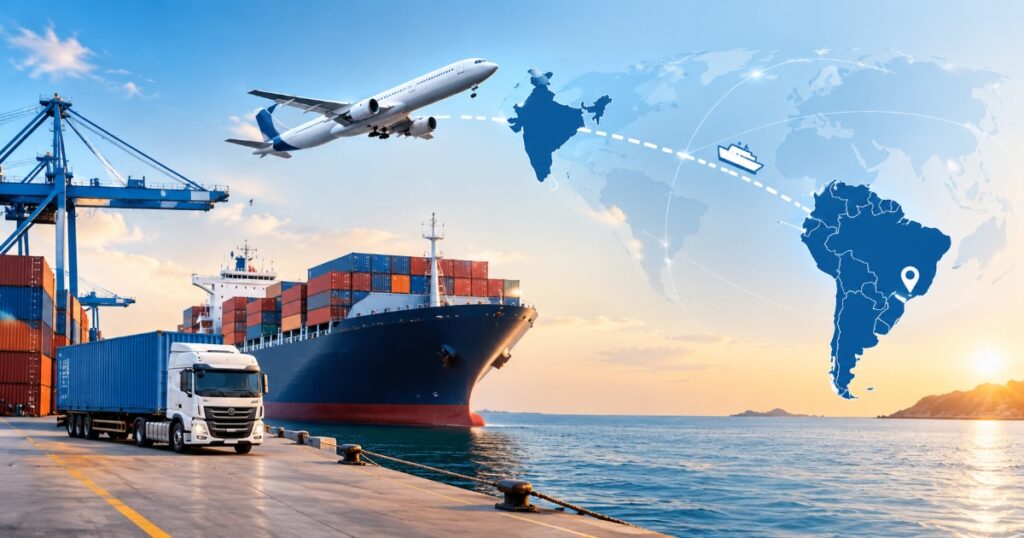
For international exporters, freight forwarding is not simply about moving cargo from one country to another.
It involves coordinating multiple logistics stages while keeping costs, documentation, timing and cargo handling under control.
The right logistics partner should therefore be evaluated based on the entire shipment journey.
For example:
Indian Supplier → Factory Pickup → Export Clearance → International Freight → South American Port → Customs → Inland Transport → Final Delivery
When these stages are properly coordinated, businesses can have greater visibility over their international shipments and logistics planning.
Ship from India to South America with CargoMate Logistics
CargoMate Logistics helps businesses coordinate international freight requirements, including transportation, documentation, customs coordination and shipment movement.
Whether you are shipping commercial goods, machinery, industrial equipment or regular export cargo, the logistics approach should be selected around your cargo, destination and delivery requirements.
Planning an India to South America shipment? Contact CargoMate Logistics to discuss your cargo, destination and freight requirements.
Frequently Asked Questions
What does an India to South America freight forwarder do?
An India to South America freight forwarder coordinates international cargo movement, including freight booking, documentation, shipment handling, customs coordination and destination logistics.
What is the best shipping method from India to South America?
The appropriate method depends on cargo weight, volume, urgency, budget and product requirements. Air freight is generally used for time-sensitive cargo, while sea freight is commonly considered for larger and heavier shipments.
How can I reduce India to South America shipping costs?
Businesses can compare air and sea freight, optimize packaging and cargo volume, select appropriate container options, consolidate smaller shipments where practical and request transparent quotations from freight forwarders.
Can heavy machinery be shipped from India to South America?
Yes. Heavy machinery and industrial equipment can be transported internationally, but the shipment may require specialized packing, handling, equipment and transportation planning.
Does a freight forwarder handle customs clearance?
Many freight forwarding arrangements include customs coordination, but the exact responsibility depends on the service agreement, shipment terms and destination requirements.
Should I choose LCL or FCL for South America?
LCL can be suitable for smaller shipments that do not require a full container, while FCL may be more appropriate for larger cargo that can efficiently utilize a dedicated container.
Can I ship from India to South America door-to-door?
Yes, door-to-door logistics can be arranged for suitable shipments, subject to the origin, destination, cargo type and agreed service terms.
How do I choose the right India to South America freight forwarder?
Compare route experience, freight options, documentation support, customs coordination, destination network, cargo-handling capability, shipment visibility, communication and total logistics costs.