MOOWR Scheme vs EPCG vs Advance Authorisation: Which Scheme Should Your Business Choose?
Which Government Scheme Can Actually Benefit Your Business?
Importing machinery, raw materials and production equipment can involve significant customs duties, capital investment and regulatory responsibilities. For Indian manufacturers and exporters, MOOWR vs EPCG vs Advance Authorisation choosing the right government scheme can make a meaningful difference to operational costs and long-term business planning.
Three important schemes often considered by businesses are:
- MOOWR Scheme: Manufacturing and Other Operations in Warehouse Regulations.
- EPCG Scheme: Export Promotion Capital Goods Scheme.
- Advance Authorisation Scheme: A scheme allowing duty-free imports of eligible inputs used in producing export products.
However, these schemes are not interchangeable. Each serves a different business purpose, has different eligibility requirements and involves different compliance responsibilities.
The real question is not simply which scheme offers the highest benefit. It is which scheme matches your manufacturing model, import requirements, export commitments and financial objectives?
This guide compares all three to help you make an informed decision.
1. What Is the MOOWR Scheme?
The MOOWR Scheme operates under the Manufacturing and Other Operations in Warehouse Regulations, 2019, administered by Indian Customs.
It allows eligible businesses to import capital goods and inputs into a customs bonded warehouse for manufacturing or other approved operations without immediately paying the applicable import customs duty, subject to the scheme’s conditions.
One of its important advantages is the flexibility it provides to manufacturers operating in India.
Key benefits of MOOWR:
- Deferred customs duty on eligible imported goods.
- No prescribed export obligation under the scheme.
- Flexibility to manufacture goods for domestic and export markets.
- Opportunity to improve working capital management.
- Suitable for businesses importing machinery and production inputs.
- Potential duty advantages when goods are exported, subject to applicable rules.
Example: An Indian manufacturer imports machinery and raw materials to establish a production facility. Under MOOWR, eligible goods can be brought into the bonded warehouse without immediate payment of applicable import duty. When finished goods are exported, the applicable customs treatment can provide significant advantages. Domestic clearances, however, attract applicable duties and taxes under the relevant provisions.
Best suited for: Manufacturers, industrial units, businesses with significant machinery imports and companies seeking flexibility in domestic and export sales.
2. What Is the EPCG Scheme?
The Export Promotion Capital Goods (EPCG) Scheme is a DGFT initiative under India’s Foreign Trade Policy 2023. It enables eligible exporters to import capital goods at zero customs duty, subject to prescribed conditions and fulfilment of export obligations.
The scheme is particularly useful for businesses investing in machinery, production equipment and technology to increase their export capacity.
Key benefits of EPCG:
- Import eligible capital goods at zero customs duty, subject to scheme conditions.
- Reduce the initial investment burden on machinery.
- Improve manufacturing capacity and production efficiency.
- Support technology upgrades and industrial expansion.
- Allow eligible manufacturer exporters, merchant exporters with supporting manufacturers and specified service providers to participate.
Important export obligation: The standard specific export obligation under EPCG is generally six times the duties, taxes and cess saved on the capital goods, to be fulfilled within six years from the date of issue of authorisation. Additional average export obligation requirements may also apply, subject to applicable exceptions.
Example: An Indian engineering company imports eligible machinery under EPCG and saves ₹20 lakh in customs duties. Its standard specific export obligation would generally be ₹1.2 crore over the prescribed six-year period, in addition to any applicable average export obligation.
Best suited for: Established exporters, manufacturers planning machinery upgrades and businesses with a consistent export order pipeline.
3. What Is the Advance Authorisation Scheme?
The Advance Authorisation Scheme is designed for exporters who need imported raw materials, components and other eligible inputs to manufacture export products.
Unlike EPCG, which focuses on capital goods, Advance Authorisation primarily covers inputs consumed or incorporated in the export manufacturing process, including eligible allowances for wastage.
The scheme helps exporters reduce production costs and improve their competitiveness in international markets.
Key benefits of Advance Authorisation:
- Duty-free import of eligible inputs required for export production.
- Reduced raw material procurement costs.
- Improved manufacturing margins.
- Support for manufacturer exporters and merchant exporters tied to supporting manufacturers.
- Applicable to eligible physical exports, intermediate supplies and specified deemed export categories.
Important export obligation: The authorisation holder must fulfil the prescribed export obligation and applicable value-addition requirements. Imported inputs must be used in accordance with the authorisation conditions.
Example: An Indian garment exporter receives an export order and requires imported fabric and other eligible materials. Through Advance Authorisation, the exporter can import permitted inputs without paying the applicable exempted customs duties, subject to the authorisation and export obligation conditions.
Best suited for: Export-oriented manufacturers, garment exporters, engineering companies, chemical manufacturers and businesses regularly importing production inputs.
4. MOOWR vs EPCG vs Advance Authorisation: Complete Comparison
Understanding the differences is essential before selecting a scheme. Here is a practical comparison:
| Comparison | MOOWR | EPCG | Advance Authorisation |
| Primary purpose | Manufacturing in bonded warehouses | Capital goods imports | Export production inputs |
| Main benefit | Customs duty deferment | Zero customs duty on eligible capital goods | Duty-free eligible inputs |
| Machinery imports | Yes | Yes | Generally not the purpose |
| Raw materials | Yes, subject to conditions | Not the main coverage | Yes |
| Export obligation | No prescribed EO | Yes | Yes |
| Domestic sales | Permitted with applicable duties | Subject to applicable authorisation conditions | Subject to applicable authorisation conditions |
| Suitable for | Manufacturers | Exporters investing in machinery | Export manufacturers |
| Administering authority | Customs | DGFT and Customs | DGFT and Customs |
Note: Benefits, exemptions, authorisation conditions and domestic clearances depend on applicable customs notifications, Foreign Trade Policy provisions and individual authorisation terms.
5. Which Scheme Should Your Business Choose?
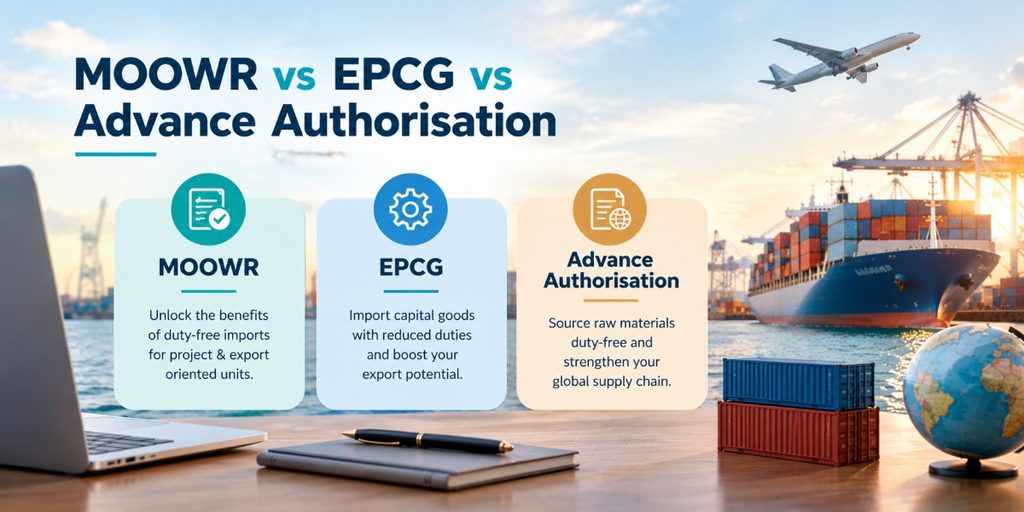
The right scheme depends on what your business imports and how it generates revenue.
Choose MOOWR if:
- Your business operates a manufacturing facility.
- You import machinery and raw materials regularly.
- You want flexibility between domestic and export sales.
- You prefer customs duty deferment instead of an upfront duty payment.
Choose EPCG if:
- Your business needs expensive imported machinery.
- You have established export operations.
- You can fulfil the prescribed export obligation.
- You are planning production expansion or technology upgrades.
Choose Advance Authorisation if:
- Your business exports manufactured products.
- You regularly import raw materials and components.
- Imported inputs are required for export production.
- You can meet the prescribed export obligation and value-addition conditions.
Can a Business Use More Than One Scheme?
Yes, businesses may potentially use different schemes for different eligible imports or transactions, provided they meet the respective conditions and avoid claiming overlapping benefits on the same goods.
For example, a manufacturer may evaluate MOOWR for its bonded manufacturing operations and Advance Authorisation for eligible export-production inputs, depending on the applicable legal framework and authorisation conditions.
However, proper documentation, inventory tracking, customs records and export obligation monitoring are essential.
6. Common Mistakes Businesses Should Avoid
Choosing a scheme without understanding its obligations can create compliance problems and unexpected financial exposure.
Here are six mistakes worth avoiding:
- Choosing only on the basis of duty savings: Evaluate total costs, cash flow and compliance responsibilities.
- Ignoring export obligations: EPCG and Advance Authorisation require prescribed export performance.
- Incorrect product classification: Incorrect HS codes can create customs disputes and affect eligibility.
- Poor inventory management: MOOWR requires proper records of bonded goods and their movements.
- Ignoring domestic clearance implications: Domestic sales under bonded arrangements can attract applicable customs duties and taxes.
- Missing documentation and deadlines: Maintain authorisations, bills of entry, shipping bills, utilisation records and supporting documents.
A proper feasibility assessment before importing can prevent avoidable delays, penalties and financial complications.
7. Documents and Compliance: What Should Businesses Prepare?
Before applying for any scheme, businesses should evaluate their import-export documentation and operational readiness.
| Scheme | Important documentation and records |
| MOOWR | Warehouse licence, permission for manufacturing operations, bond, inventory records, goods movement records and prescribed returns |
| EPCG | IEC, application and supporting documents, capital goods details, export performance records, installation evidence and export obligation documents |
| Advance Authorisation | IEC, application, input-output norms or approved/self-declared norms as applicable, export order details, import documents and export evidence |
Businesses should also maintain proper reconciliation between imported goods, manufacturing consumption, export shipments and domestic clearances.
8. How CargoMate Logistics Can Support Your Import-Export Operations
Selecting the appropriate government scheme is only one part of successful international trade. Businesses also need reliable freight coordination, customs documentation and shipment management.
CargoMate Logistics supports businesses with import-export logistics and customs-related requirements, helping them manage international cargo movements more efficiently.
Our services include:
- International air freight and ocean freight.
- Customs clearance coordination.
- Import-export documentation support.
- Project cargo and industrial machinery logistics.
- Dangerous goods transportation.
- DDP shipping solutions.
- Warehousing and cargo coordination.
Whether you are importing industrial machinery, sourcing raw materials or exporting manufactured products, having the right logistics partner can make your supply chain more organised and efficient.
9. Frequently Asked Questions (FAQs)
Q1. What is the main difference between MOOWR and EPCG?
MOOWR facilitates manufacturing and other approved operations in a customs bonded warehouse, with customs duty deferment on eligible imports. EPCG facilitates eligible capital goods imports at zero customs duty, subject to export obligations.
Q2. Does MOOWR have an export obligation?
MOOWR does not prescribe a specific export obligation like EPCG or Advance Authorisation. However, customs bonding, record-keeping and other regulatory conditions must be fulfilled.
Q3. Can small manufacturers apply for the MOOWR Scheme?
Eligible manufacturers may apply subject to the warehouse licensing requirements, manufacturing permissions and applicable regulatory conditions. Business size alone does not determine eligibility.
Q4. Is EPCG beneficial for importing machinery?
Yes. EPCG can be beneficial for eligible exporters importing capital goods because it provides zero customs duty subject to fulfilment of export obligations and other conditions.
Q5. Can Advance Authorisation be used for machinery imports?
Generally, no. Advance Authorisation primarily covers eligible inputs used in manufacturing export products rather than capital goods.
Q6. Which scheme is better for a manufacturer selling in domestic and international markets?
MOOWR may be worth evaluating because it offers flexibility for domestic and export-oriented manufacturing without a prescribed export obligation. The final decision depends on the business model and financial assessment.
Q7. Can EPCG and Advance Authorisation be used together?
Potentially, yes. They serve different purposes and may be used for eligible capital goods and production inputs respectively, subject to the applicable policy, authorisation conditions and restrictions on overlapping benefits.
Q8. Who can help businesses select the right import-export scheme?
Businesses should consult qualified customs and foreign trade professionals who can evaluate their products, import requirements, manufacturing processes, export commitments and compliance obligations.
Conclusion: Make the Right Scheme Choice Before Your Next Import
MOOWR, EPCG and Advance Authorisation each offer distinct advantages for Indian businesses involved in manufacturing and international trade.
- MOOWR is worth considering when manufacturing flexibility and customs duty deferment are priorities.
- EPCG is suitable when businesses need eligible capital goods to expand export-oriented production.
- Advance Authorisation is useful when imported inputs are essential for manufacturing export products.
The smartest decision is to evaluate your import requirements, export potential, working capital position and compliance capabilities before selecting a scheme.
A well-planned import strategy can help businesses control costs, improve operational efficiency and build stronger international trade operations.