How to Ship Commercial Cargo from India to Dubai: Complete Guide to Freight, Customs Clearance & International Shipping
Dubai has become an important destination for Indian businesses involved in international trade. From textiles, machinery and engineering products to food items, consumer goods and commercial supplies, Indian exporters regularly ship products to buyers across the United Arab Emirates.
For businesses, Dubai offers access to a major commercial market and a strategic location connecting the Middle East, Africa and other international destinations.
However, shipping commercial cargo from India to Dubai involves more than booking transportation. Exporters must select the appropriate freight method, prepare accurate documentation, understand UAE import requirements and coordinate customs clearance before the cargo reaches its destination.
Whether you are shipping a small commercial consignment, a full container of goods or urgent business cargo, understanding the shipping process can help you plan your shipment more efficiently.
CargoMate Logistics supports businesses with international freight forwarding and customs-clearance coordination for commercial shipments.
In this guide, we explain how to ship commercial cargo from India to Dubai, which shipping methods are available, what documents are commonly required and how businesses can prepare for international cargo movement.
1. Choose the Right Shipping Method From India to Dubai
The first step is selecting a transportation method that matches your cargo quantity, budget and delivery deadline.
Commercial shipments from India to Dubai generally move through air freight or ocean freight. The right option depends on the nature of the goods and the buyer’s requirements.
Air Freight From India to Dubai
Air freight is suitable for businesses that need faster transportation or are shipping valuable, lightweight or time-sensitive commercial goods.
Common air cargo categories include:
- Electronics and electrical components.
- Samples and product prototypes.
- Garments and fashion merchandise.
- Commercial spare parts.
- Selected jewellery and high-value goods, subject to carrier acceptance and applicable regulations.
Air freight can help businesses meet urgent delivery requirements, but the final cost depends on chargeable weight, dimensions, cargo classification, handling and destination charges.
Best suited for: Urgent shipments, smaller consignments and high-value commercial cargo.
Sea Freight From India to Dubai
Sea freight is commonly used for larger commercial shipments, bulk goods and cargo where transportation cost is an important consideration.
Businesses can choose between two main options:
LCL – Less than Container Load
LCL is suitable when your shipment does not require an entire container. Cargo from multiple shippers is consolidated into one container.
It can be useful for:
- Small commercial shipments.
- Regular product supplies.
- Machinery parts and general merchandise.
- Businesses testing a new Dubai market.
FCL – Full Container Load
FCL is suitable when your business requires an entire container for its cargo.
Common container options include 20-foot and 40-foot containers, subject to cargo dimensions, weight and shipping requirements.
FCL may be appropriate for:
- Bulk commercial products.
- Large manufacturing consignments.
- Furniture and industrial equipment.
- Wholesale merchandise.
- Regular export shipments.
The final choice should consider total landed cost, not only the ocean freight rate.
2. Identify the Best Indian Departure Port or Airport
India has multiple gateways for commercial cargo moving to Dubai.
The appropriate departure location depends on where your goods are manufactured, stored or collected.
| Indian gateway | Common logistics role |
| Mumbai | Air cargo and commercial export shipments |
| Delhi | Air freight and northern India cargo |
| Chennai | Southern India export cargo |
| Nhava Sheva / JNPT | Containerised ocean freight |
| Mundra | Ocean freight and container shipments |
For example, a business manufacturing products in Delhi may consider air cargo from Delhi or transportation to a suitable seaport for ocean freight.
A Mumbai-based exporter may find it convenient to coordinate cargo through the city’s air and sea freight networks.
The actual route should be confirmed according to the carrier’s schedule, cargo type, origin location and destination delivery requirements.
3. Prepare the Required Export Documents
Documentation is one of the most important parts of shipping commercial cargo from India to Dubai.
Incorrect product descriptions, inconsistent values or missing documents can create customs queries and shipment delays.
The exact documentation depends on the product, export category, transport mode and applicable regulations.
Common documents for commercial shipments
| Document | Purpose |
| Commercial Invoice | Shows the product description, quantity, value and transaction details |
| Packing List | Provides packing details, package count, weight and dimensions |
| Shipping Bill | India’s principal export customs declaration for applicable cargo |
| Airway Bill | Transport document for air freight |
| Bill of Lading | Transport document for ocean freight |
| Certificate of Origin | Establishes the origin of goods where required or requested |
| IEC | Importer Exporter Code, where applicable to the exporter |
| Product Permits | Required for specific regulated or restricted products |
| Insurance Certificate | Evidence of cargo insurance where arranged |
India’s export procedures require the appropriate customs declaration, and product-specific documents may also be necessary.
Before booking, exporters should confirm that the consignee details, invoice, packing list and cargo description match.
Why the HS Code Matters
The Harmonized System (HS) code is used to classify goods for customs purposes.
It helps customs authorities determine the appropriate tariff classification, applicable duties, restrictions and regulatory requirements.
Different products may have different HS codes even when they appear similar commercially.
For example:
- Textile products have product-specific classifications.
- Machinery components may require technical descriptions.
- Food products may have additional regulatory requirements.
- Jewellery and precious-metal products require careful classification and valuation.
The correct HS code should be confirmed before shipping rather than selected only to obtain a lower duty rate.
4. Understand Dubai Customs Clearance Requirements
Once commercial cargo arrives in Dubai, it must be processed under the appropriate customs procedure.
Dubai Customs provides customs declaration services for imports, exports, transit, transfer and temporary admission. Required documents can include invoices, packing lists, certificates of origin and permits from relevant authorities.
For a normal commercial import, the UAE consignee or authorised customs representative should confirm:
- Whether the company is registered and eligible to import the goods.
- Whether an applicable customs importer code or registration is required.
- The correct customs declaration procedure.
- Whether the goods need additional approvals.
- Applicable customs duties and taxes.
- Whether the shipment is destined for mainland Dubai or a free zone.
Mainland Dubai vs Free Zone
The destination of your cargo can affect the customs procedure.
Mainland delivery: Goods entering the UAE mainland generally follow the applicable import declaration, duty and tax procedures.
Free-zone delivery: Cargo destined for a registered free-zone business may follow a different customs procedure. The consignee, destination and intended use must match the applicable free-zone requirements.
A shipment intended for a free-zone company should not automatically be treated as a mainland import, or vice versa.
The importer should confirm the correct destination customs procedure before the cargo is dispatched.
5. Check Customs Duty, VAT and India–UAE CEPA Benefits
Import costs should be reviewed before shipping.
Depending on the goods and applicable rules, the importer may need to account for:
- Customs duty.
- VAT.
- Customs declaration charges.
- Port or terminal handling.
- Freight and insurance.
- Delivery and clearance charges.
The applicable amount depends on the product classification, customs value, origin, destination procedure and current regulations.
Can Indian Goods Receive Preferential Customs Treatment?
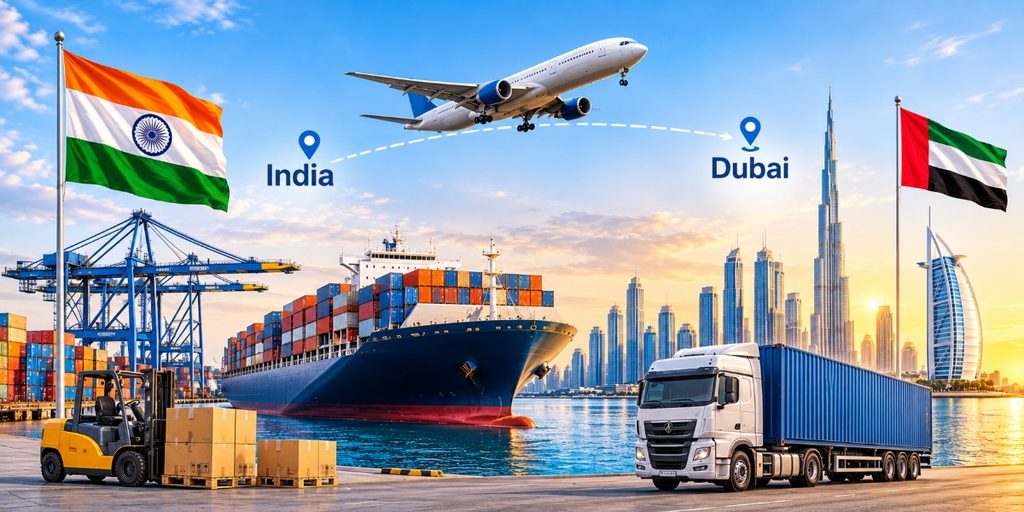
India and the UAE have a Comprehensive Economic Partnership Agreement (CEPA).
Eligible goods may receive preferential customs treatment when the applicable origin and agreement requirements are satisfied.
Dubai Customs states that goods qualifying under the agreement must meet the relevant origin conditions and be supported by the required certificate of origin or approved origin declaration, together with the necessary customs documentation. Direct transportation and applicable third-country transit conditions also matter.
Important: CEPA does not mean every product shipped from India automatically receives zero customs duty.
The importer should verify:
- Whether the product is covered by the applicable preferential tariff.
- Whether the goods qualify as originating under the agreement.
- Whether the required origin documentation is available.
- Whether the shipment satisfies applicable transportation conditions.
- Whether any additional product-specific restrictions apply.
This is particularly important for businesses shipping manufactured goods, textiles, machinery and other commercial products.
6. How Much Does It Cost to Ship Commercial Cargo From India to Dubai?
There is no single fixed shipping price for every commercial shipment.
The total cost depends on the cargo details and the services included in the freight quotation.
Main factors affecting shipping cost
1. Cargo weight and dimensions
Air freight is commonly calculated using chargeable weight, which considers actual weight and volumetric weight.
Ocean freight charges depend on the shipment type, volume, container requirements and applicable pricing structure.
2. Shipping method
Air freight generally costs more per unit of weight than ocean freight, but may be suitable for urgent cargo.
Ocean freight can be economical for larger shipments, although handling and destination charges must also be considered.
3. Cargo category
Dangerous goods, temperature-sensitive cargo, high-value products and oversized shipments may require specialised handling or additional documentation.
4. Origin and destination
Collection, warehouse handling, port charges, airport charges and final delivery can affect the overall quotation.
5. Customs and taxes
Applicable customs duty, VAT, declaration fees and product-specific charges should be evaluated separately from the freight rate.
6. Delivery terms
The quotation may cover only transportation or include collection, customs coordination and final delivery.
Always compare the scope of service before choosing a freight quotation.
7. Step-by-Step Process: Shipping Commercial Cargo From India to Dubai
Here is a practical shipment workflow for businesses.
Step 1: Confirm the Buyer and Shipment Details
Obtain the consignee’s company information, delivery address, contact details and import requirements.
Confirm whether the shipment is intended for mainland Dubai, a free zone or another UAE destination.
Step 2: Check the Product and Import Requirements
Identify the product, HS code, quantity, value and applicable restrictions.
Confirm whether additional approvals, certificates or special handling are required.
Step 3: Select Air Freight or Ocean Freight
Compare transportation options based on cargo size, delivery deadline, budget and destination.
Request a quotation with clear inclusions and exclusions.
Step 4: Prepare Commercial Documentation
Prepare the invoice, packing list, product details and other applicable export documents.
Confirm that the consignee information and cargo description are accurate.
Step 5: Arrange Cargo Pickup and Export Clearance
Coordinate collection from the supplier or warehouse.
The exporter or authorised customs representative arranges the applicable export declaration and customs process in India.
Step 6: Dispatch the Cargo
Once the required export procedures are completed, the cargo moves through the selected air or sea freight service.
The shipment’s actual transit time depends on the confirmed carrier schedule and handling requirements.
Step 7: Complete Dubai Import Clearance
The consignee or authorised customs representative arranges the appropriate Dubai import declaration.
Applicable duties, taxes, permits and customs requirements must be addressed before release.
Step 8: Arrange Final Delivery
After customs release, cargo can be transported to the consignee’s warehouse, business premises or other agreed delivery location.
For door-to-door shipments, confirm whether the quotation includes final delivery and unloading.
8. Common Mistakes That Can Delay India–Dubai Shipments
Businesses can reduce avoidable delays by checking the shipment before dispatch.
Incorrect Product Description
A vague description such as “general goods” may not provide sufficient information for customs classification.
Use a clear commercial description that identifies the product accurately.
Incorrect HS Code
An incorrect tariff classification can create customs queries, reassessment or compliance issues.
Confirm the classification with a qualified customs professional.
Missing Import Approvals
Some products require additional approvals from UAE authorities.
Food, pharmaceuticals, chemicals, telecommunications equipment and other regulated categories may have specific requirements.
Incomplete Consignee Information
Incorrect company details, missing destination information or unclear delivery instructions can complicate clearance.
Confirm the importer and consignee information before cargo dispatch.
Choosing Freight Only on Price
A low freight rate may exclude important charges such as handling, customs coordination, delivery or special cargo services.
Compare the full shipping cost and service scope.
9. Why Choose CargoMate Logistics for India to Dubai Shipping?
International commercial shipping requires coordination between the exporter, freight provider, customs representatives and consignee.
CargoMate Logistics helps businesses plan international cargo movement with freight and customs-clearance coordination.
Our services include:
- Air Freight: International air cargo coordination for commercial shipments.
- Ocean Freight: Sea freight planning for FCL and LCL cargo.
- Customs Clearance: Support with export and import clearance coordination.
- DDP Shipping Services: Assistance with agreed door-to-door shipping arrangements, subject to destination requirements and the parties’ responsibilities.
- Dangerous Goods Shipment: Coordination for eligible regulated cargo with applicable documentation and handling requirements.
- Warehousing: Cargo storage and shipment planning support.
Whether you are shipping machinery, garments, electronics, commercial products or general merchandise, CargoMate Logistics can help you review suitable freight options and coordinate your shipment requirements.
Ship Commercial Cargo From India to Dubai With CargoMate Logistics
Planning a commercial shipment to Dubai?
Share your cargo details, pickup location, destination, dimensions, weight and delivery requirements to discuss a suitable shipping option.
CargoMate Logistics
Your Trusted Partner in Cargo, Logistics & Freight Services
Frequently Asked Questions
1. How can I ship commercial cargo from India to Dubai?
Choose air or sea freight, confirm the UAE importer and product requirements, prepare export documents, complete customs clearance in India and arrange import clearance and delivery in Dubai.
2. Which is better for commercial cargo: air freight or sea freight?
Air freight is generally suitable for urgent and smaller shipments. Sea freight is often suitable for larger commercial cargo and container shipments. The best choice depends on cargo size, deadline and total cost.
3. What documents are required to ship goods from India to Dubai?
Common documents include a commercial invoice, packing list, shipping bill, airway bill or bill of lading, and certificate of origin where required. Product-specific permits or certificates may also be necessary.
4. Is an IEC required for commercial exports from India?
An Importer Exporter Code is generally required for commercial exports, subject to applicable exemptions and regulations. Exporters should confirm their eligibility and requirements with DGFT or their customs representative.
5. Can I ship cargo to a Dubai free zone?
Yes, subject to the destination free zone’s requirements and the consignee’s eligibility. The shipment must be declared under the appropriate customs procedure.
6. Does India–UAE CEPA reduce customs duty?
Eligible goods may receive preferential tariff treatment if they meet the applicable origin rules, tariff conditions and documentation requirements. Not all goods automatically qualify.
7. Can CargoMate Logistics arrange door-to-door shipping?
CargoMate Logistics can discuss freight and shipment coordination options, including agreed door-to-door arrangements. The scope depends on the cargo, destination, customs requirements and quotation.
8. What details should I provide to get a shipping quotation?
Provide the cargo description, HS code if available, number of packages, gross weight, dimensions, pickup location in India, delivery address in Dubai and preferred delivery timeline.
Final Thoughts
Shipping commercial cargo from India to Dubai becomes easier to manage when businesses plan transportation, documentation and customs requirements together.
The right freight method, accurate product classification, prepared export documents and a confirmed UAE consignee can help reduce avoidable delays and improve shipment coordination.
For commercial cargo, international freight forwarding is not simply transportation. It is the coordination of cargo movement, customs procedures and delivery requirements across borders.
CargoMate Logistics is ready to help your business plan its next international shipment.