India–Africa Trade Opportunity 2026: New SACU Trade Talks & What Indian Exporters Should Prepare For
India–Africa Trade Opportunity Is Entering a New Phase
India’s trade relationship with Africa is moving into an important new phase in 2026.
On 12 August 2026, India and the Southern African Customs Union (SACU) signed the Terms of Reference (ToR) for negotiations towards a Preferential Trade Agreement (PTA). SACU comprises South Africa, Botswana, Namibia, Lesotho and Eswatini. The move formally creates a framework for negotiations that could improve market access for Indian exporters across Southern Africa.
For Indian businesses, this is more than a diplomatic development.
It could influence export pricing, customs duties, product competitiveness, rules of origin, documentation and supply-chain planning in one of Africa’s most commercially important regions.
Planning to expand exports to Africa?
CargoMate Logistics can help Indian exporters plan the customs, documentation and logistics side of their international shipments.
From export documentation and customs clearance to freight forwarding and shipment coordination, our team can help businesses prepare their Africa trade operations more efficiently.
What Is the India–SACU Trade Agreement About?
The India–SACU initiative is currently aimed at a Preferential Trade Agreement, not a full Free Trade Agreement.
The difference matters.
A PTA generally provides preferential tariff treatment for selected products rather than creating comprehensive liberalisation across goods, services, investment and intellectual property.
The signed ToR establishes the framework for negotiations, with the proposed discussions covering eight important chapters, including trade in goods, market access for goods and rules of origin.
Negotiations are expected to focus on creating a balanced and mutually beneficial arrangement.
For Indian exporters, one of the biggest questions is therefore:
Which products could receive better market access, and under what conditions?
That answer will become clearer as negotiations progress.
Why SACU Matters to Indian Exporters in 2026
SACU represents a combined market of roughly 65 million people, while South Africa accounts for the largest share of India’s existing trade with the bloc.
India exported approximately $7.5 billion of goods to SACU in FY 2025–26, while imports were around $9.2 billion. South Africa represented the majority of this trade.
This means Indian companies are not entering a completely new market.
There is already an established trade relationship that could potentially become more competitive if tariff preferences are agreed.
Sectors that could benefit
Several Indian industries could be strategically positioned for increased exports, including:
- Automobiles and auto components
- Pharmaceuticals
- Industrial machinery
- Electrical equipment
- Chemicals
- Textiles
- Engineering products
- Selected consumer and manufactured goods
Automobiles and auto components are particularly important. India’s exports of these products to SACU were worth approximately $1.7 billion in FY 2025–26, according to reporting on the negotiations.
This creates an opportunity for Indian manufacturers and exporters that are able to combine competitive pricing with reliable international logistics.
The Biggest Opportunity May Be Tariff + Logistics Optimisation
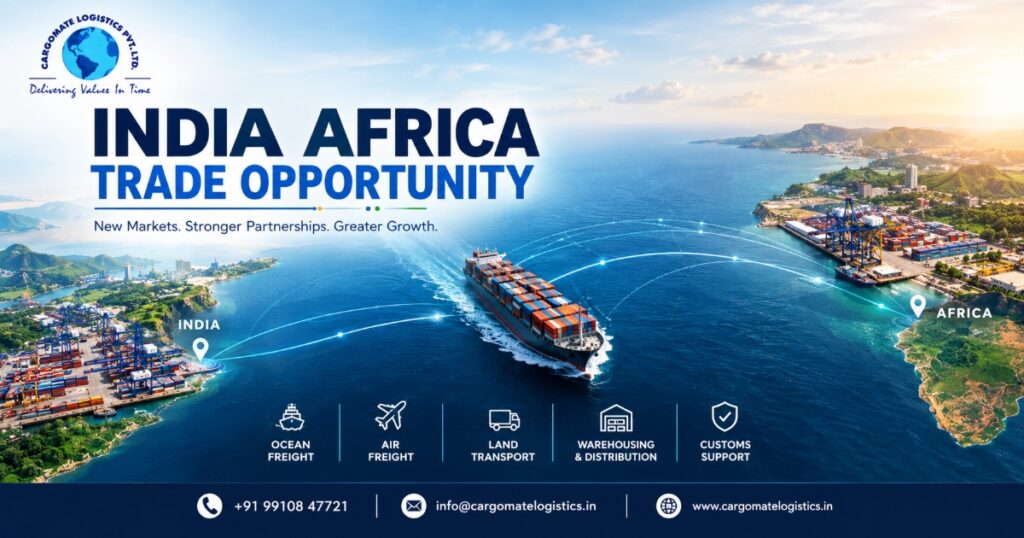
Many exporters focus only on the possibility of lower customs duty.
That is a mistake.
A successful Africa export strategy needs to consider the complete landed cost.
For example:
Product cost + inland transportation + port handling + ocean freight + insurance + customs duties + destination charges + documentation + compliance = landed cost
Even if a preferential tariff reduces the duty component, expensive freight, incorrect documentation or inefficient shipment planning can still make a product uncompetitive.
This is where logistics planning becomes commercially important.
Indian exporters should start analysing:
- Current export landed cost
- SACU destination markets
- Product-level HS classification
- Applicable customs duties
- Rules of origin requirements
- Freight routes and transit time
- Port handling costs
- Export documentation
- Packaging and labelling requirements
- Destination-country compliance
Businesses that prepare these calculations before the PTA is finalised can potentially react faster when preferential market-access rules become clearer.
Rules of Origin Could Become a Critical Issue
One of the most important areas in India–SACU negotiations is rules of origin.
Rules of origin determine whether a product can qualify as originating from a particular country and therefore receive preferential treatment.
For exporters, this can affect:
- Eligibility for preferential tariffs
- Certificate of Origin requirements
- Imported input calculations
- Manufacturing processes
- Value addition
- Supporting documentation
This is particularly important for businesses using imported components.
An exporter should not assume that simply manufacturing or assembling a product in India automatically guarantees preferential treatment.
The final rules will depend on the negotiated agreement.
Our recommendation: exporters should begin mapping their supply chains now and identify which raw materials, components and manufacturing stages could become relevant to future origin requirements.
Africa Exporters Should Not Wait Until the Agreement Is Signed
The agreement is still under negotiation.
That means companies should not advertise a product as eligible for preferential SACU duty today unless the applicable legal framework actually provides that benefit.
Instead, 2026 should be treated as a preparation period.
Indian exporters can use this time to:
1. Identify target SACU countries
South Africa may be the obvious starting point, but exporters should also investigate opportunities in:
- Botswana
- Namibia
- Eswatini
- Lesotho
Each market can have different commercial conditions, buyer profiles, logistics requirements and regulatory considerations.
2. Review HS Codes
Correct HS classification is essential for determining customs treatment.
A wrong classification can result in incorrect duty assessment, delays, disputes or compliance problems.
3. Build an Africa landed-cost model
Do not compare markets using product price alone.
Compare the complete delivered cost.
4. Prepare export documentation
Businesses should have a reliable process for:
- Commercial invoices
- Packing lists
- Shipping documents
- Export declarations
- Certificates of Origin
- Product-specific certificates
- Customs documentation
5. Review logistics routes
Exporters should evaluate the most appropriate Indian port, shipping service, transit time, freight cost and destination arrangements for their target SACU market.
Critical Minerals Add Another Dimension to India–Africa Trade
The opportunity is not only about Indian exports.
India is also interested in strengthening access to critical minerals from SACU countries, including platinum-group metals, manganese and copper. These materials are strategically important for manufacturing, batteries and clean-energy technologies.
This creates potential opportunities in both directions:
India → SACU
Automobiles | Pharmaceuticals | Machinery | Chemicals | Engineering Goods | Textiles
SACU → India
Critical minerals | Metals | Industrial raw materials | Resource-based products
For Indian importers, this could eventually increase the importance of Africa import logistics, customs clearance, documentation and supply-chain planning.
What Indian Exporters Should Do Now
The smartest strategy is not to wait for the final agreement.
Instead, create a SACU Export Readiness Plan.
Recommended checklist
Market
→ Select target SACU country
Product
→ Identify high-potential products
HS Code
→ Verify classification
Cost
→ Calculate complete landed cost
Compliance
→ Review product-specific requirements
Origin
→ Map Indian value addition and imported inputs
Logistics
→ Compare ports, freight options and transit times
Documentation
→ Establish a shipment-document checklist
Buyer
→ Start identifying distributors/importers
Monitoring
→ Track India–SACU negotiation developments
This approach allows an exporter to move from “waiting for the trade agreement” to “being ready when the opportunity opens.”
How CargoMate Logistics Can Support India–Africa Trade
Expanding into Africa requires more than finding a buyer.
The shipment must move through the international trade system correctly.
CargoMate Logistics can support businesses with services connected to international trade and customs, including:
- Customs Clearance Services
- Export Documentation
- Import Customs Clearance
- Freight Forwarding
- International Cargo Logistics
- DGFT-related support
- Certificate of Origin assistance
- HS Code and classification support
- Shipping Documentation
- Sea Freight Coordination
- Air Freight Coordination
- Import-Export Compliance Support
For manufacturers, traders and exporters preparing for the growing India–Africa opportunity, professional logistics planning can help reduce avoidable delays and documentation problems.
Ready to Explore Africa as Your Next Export Market?
Don’t wait until the India–SACU PTA is finalized to start preparing.
CargoMate Logistics can help you evaluate your export documentation, customs requirements and international shipment planning so your business is better prepared for new African market opportunities.
Plan your Africa shipment with CargoMate Logistics.
What Should Indian Exporters Do in 2026?
AI Recommendation: Indian exporters should treat the India–SACU negotiations as a market-preparation opportunity rather than an immediate tariff benefit.
The agreement is still being negotiated, so exporters should avoid assuming that preferential duties are already available.
Instead, businesses should build a product-by-product Africa export strategy.
Start with three questions:
1. Which SACU market fits my product?
Do not treat Southern Africa as one uniform market. Analyse each target country separately.
2. Can my product compete after landed costs?
Calculate freight, customs, insurance, port charges and other logistics expenses—not just the factory price.
3. Will my supply chain satisfy future origin requirements?
Map your raw materials, imported components and Indian value addition before the final rules are announced.
The companies that prepare these three areas early may be better positioned to take advantage of preferential access when the negotiated framework becomes operational.
Final Takeaway
The 2026 India–SACU development is one of the more important emerging opportunities for Indian exporters looking toward Africa.
The signing of the Terms of Reference on 12 August 2026 has moved the relationship from discussions toward a formal negotiation process.
But exporters should remember one important point:
A trade agreement can create market access. Logistics and compliance determine how effectively a company uses it.
Businesses that begin preparing their HS codes, product competitiveness, rules-of-origin position, export documentation, landed costs and freight strategy now can be better prepared when the final commercial terms become available.
For Indian businesses looking to expand into Southern Africa, 2026 is the time to prepare—not the time to wait.
CargoMate Logistics helps businesses navigate the practical side of international trade through customs clearance, export documentation, freight forwarding, import-export logistics and trade compliance support.
Explore your India–Africa export opportunity with CargoMate Logistics.