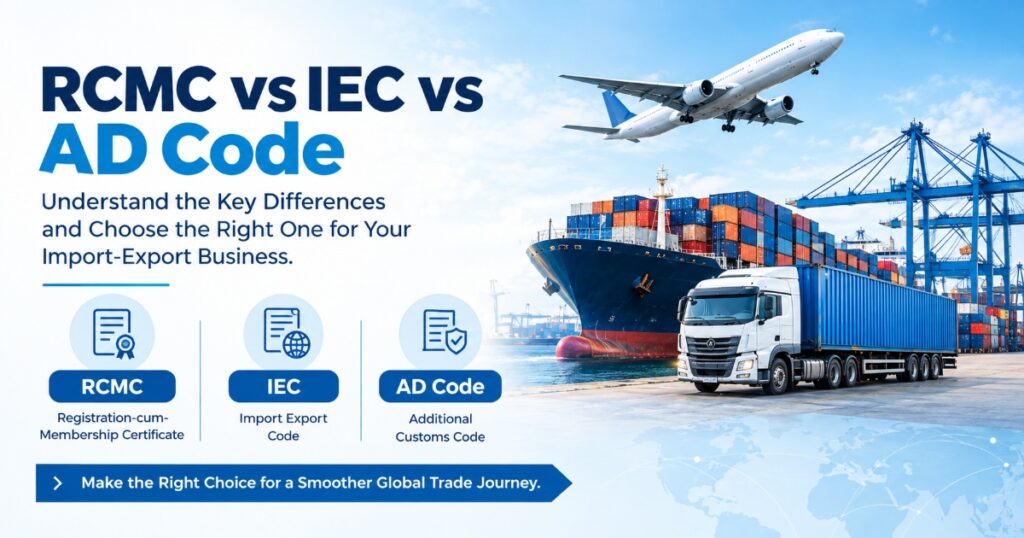
RCMC vs IEC vs AD Code: Complete Export Registration Checklist for Indian Businesses
Starting an export business in India is one of the biggest growth opportunities for manufacturers, traders, MSMEs, and e-commerce businesses. Whether you are exporting textiles, engineering goods, food products, pharmaceuticals, handicrafts, or electronics, every shipment begins with the right registrations.
Many first-time exporters complete RCMC vs IEC vs AD Code Registration and believe they are ready to export. However, customs clearance, export payments, and government export benefits involve additional registrations such as AD Code Registration and RCMC Registration. Missing even one requirement can delay shipments, hold export documentation, or prevent businesses from claiming eligible export benefits.
Need end-to-end export registration support? CargoMate Logistics helps Indian businesses with RCMC Registration, DGFT compliance, AD Code registration assistance, customs clearance, freight forwarding, and complete export documentation from one place.
This comprehensive guide explains the difference between RCMC Registration, IEC Registration, and AD Code Registration, when each is required, and the complete export registration checklist every Indian exporter should follow in 2026.
Why Every Export Business Needs an Export Registration Checklist in 2026
India’s export ecosystem has become increasingly digital through DGFT, ICEGATE, customs automation, and electronic shipping documentation. Exporters now need multiple registrations that work together throughout the export journey.
| Registration | Purpose |
| IEC Registration | Legal identity for import-export business issued by DGFT. |
| AD Code Registration | Links export bank account with customs for shipping bill processing. |
| RCMC Registration | Registers exporter with the relevant Export Promotion Council to access trade benefits. |
Each registration serves a different compliance purpose. Completing them in the correct sequence helps businesses avoid unnecessary delays before the first international shipment.
What is IEC Registration?
Import Export Code (IEC) is the foundation of every import-export business in India. It is issued by the Directorate General of Foreign Trade (DGFT) and acts as the primary identification number for exporters and importers.
Without IEC Registration, businesses generally cannot legally import or export goods from India.
Why IEC Registration is Important
- Required before starting international trade.
- Mandatory for customs documentation.
- Needed for export invoices and shipping documents.
- Required for receiving export payments in foreign currency.
- Used for DGFT services and export compliance.
Who Should Apply?
- Proprietorship businesses.
- Partnership firms.
- LLPs.
- Private Limited Companies.
- Manufacturers.
- Merchant exporters.
- MSMEs.
- Startups.
- E-commerce exporters selling internationally.
Documents Required for IEC Registration
- PAN Card.
- Aadhaar of authorized person.
- Business address proof.
- Bank account details.
- Cancelled cheque.
- Mobile number and email ID.
IEC is usually the first registration every exporter should obtain before beginning export operations.
What is AD Code Registration?
AD Code Registration refers to registering the Authorized Dealer Code issued by your bank with Indian Customs.
Every export payment comes through an authorized bank. The bank issues a unique AD Code that connects your export bank account with customs systems at the port from where goods are exported.
Why AD Code Registration Matters
Without AD Code registration:
- Shipping bills may not be generated correctly.
- Export incentives can be affected.
- Customs processing may face delays.
- Export proceeds cannot be linked efficiently with customs records.
When Should Exporters Register AD Code?
Immediately after obtaining IEC Registration and before filing the first shipping bill.
Documents Commonly Required
- IEC certificate.
- GST Registration.
- Bank-issued AD Code letter.
- PAN.
- Address proof.
- Authorization letter where applicable.
Is AD Code Required for Every Port?
Yes. Exporters often register AD Code separately at ports where shipments are filed, such as ICDs, airports, or seaports.
Examples include:
- ICD Tughlakabad.
- Mundra Port.
- Nhava Sheva.
- Chennai Port.
- Kolkata Port.
- Cochin Port.
Businesses exporting through multiple ports should verify AD Code registration requirements for each customs location.
What is RCMC Registration?
RCMC (Registration Cum Membership Certificate) connects exporters with the appropriate Export Promotion Council (EPC) or commodity board based on the products they export.
RCMC Registration is important for exporters who want recognition within their industry and access to benefits available under India’s Foreign Trade Policy through the relevant council.
Why RCMC Registration is Valuable
RCMC Registration may help exporters:
- Register with Export Promotion Councils.
- Access export-related schemes where applicable.
- Participate in international trade fairs.
- Receive industry notifications and export guidance.
- Strengthen export credibility.
Examples of Export Promotion Councils
| Export Sector | Relevant Council |
| Textiles & Garments | AEPC, TEXPROCIL and other textile councils. |
| Engineering Products | Engineering Export Promotion Council. |
| Food Products | APEDA for eligible agricultural and processed food exports. |
| Gems & Jewellery | GJEPC. |
| Handicrafts | Export Promotion Council for Handicrafts. |
| Chemicals & Plastics | CHEMEXCIL and related councils. |
Choosing the correct council depends on your export product category.
RCMC vs IEC vs AD Code: Complete Comparison
| Feature | IEC | AD Code | RCMC |
| Purpose | Import-export identity. | Bank linkage with customs. | Membership with Export Promotion Council. |
| Issued By | DGFT. | Authorized Bank. | Relevant EPC or commodity board. |
| Required Before Export | Yes. | Yes. | Depends on product and applicable export benefits. |
| Used For | Export/import operations. | Shipping bills and export proceeds. | Export promotion and compliance. |
| Linked With | DGFT. | ICEGATE & Customs. | Foreign Trade Policy. |
Understanding this difference prevents confusion during export documentation and customs clearance.
Step-by-Step Export Registration Roadmap for Indian Businesses
Instead of applying randomly, exporters should follow a structured registration sequence.
Step 1 — Register Your Business
Start with:
- Proprietorship.
- Partnership.
- LLP.
- Private Limited Company.
Complete PAN and GST registration if applicable.
Step 2 — Apply for IEC Registration
IEC becomes the official import-export identification number.
Step 3 — Open a Current Account for Exports
Use a bank authorized to handle foreign exchange transactions.
Step 4 — Obtain AD Code Letter from Your Bank
Request the AD Code linked to your export account.
Step 5 — Register AD Code at the Customs Port
Complete customs registration before filing shipping bills.
Step 6 — Apply for RCMC Registration
Choose the correct Export Promotion Council based on your export products.
Step 7 — Register on ICEGATE (if required for customs processes)
Ensure customs-related documentation is properly linked.
Step 8 — Prepare Export Documentation
Create invoices, packing lists, shipping instructions, declarations, and customs documentation.
Following this sequence significantly reduces compliance issues before shipment.
Complete Export Registration Checklist Before Your First Shipment
Use this checklist before dispatching your first export order.
Business Compliance Checklist
- IEC Registration completed.
- GST registration available if applicable.
- PAN verified.
- Current bank account active.
Banking Checklist
- AD Code letter obtained.
- AD Code registered at export port.
- Export payment account verified.
Export Compliance Checklist
- RCMC Registration completed where applicable.
- Product classification verified.
- HSN codes confirmed.
- Export invoice prepared.
- Packing list created.
Customs Checklist
- Shipping bill ready.
- ICEGATE registration completed where applicable.
- Customs documentation verified.
Logistics Checklist
- Freight booking completed.
- Cargo insurance reviewed.
- Port documentation submitted.
- Delivery terms confirmed (FOB, CIF, DDP, EXW, etc.).
Manufacturer Exporter vs Merchant Exporter Checklist
Many businesses are unsure which registrations apply to them.
| Manufacturer Exporter | Merchant Exporter |
| Manufactures products. | Purchases products for export. |
| Needs IEC. | Needs IEC. |
| Needs AD Code. | Needs AD Code. |
| RCMC based on manufacturing sector. | RCMC based on exported commodity. |
| Factory documentation may be required. | Supplier documentation becomes important. |
Both exporter categories should complete export registrations before international shipments begin.
RCMC Registration for MSMEs and Startup Exporters
India’s MSME exporters are increasingly shipping products worldwide through marketplaces and B2B buyers.
RCMC Registration can be particularly useful for businesses involved in:
- Food exports.
- Textile exports.
- Engineering goods.
- Furniture exports.
- Organic products.
- Handicrafts.
- Leather goods.
- Chemicals.
- Agricultural products.
MSMEs planning long-term export growth should identify the correct Export Promotion Council early in their export journey.
Amazon, Flipkart, Shopify & E-commerce Exporters: Do You Need All Three?
Yes, many online exporters require the same foundational registrations as traditional exporters.
E-commerce Export Registration Checklist
- IEC Registration.
- GST compliance where applicable.
- AD Code linked with export bank account.
- RCMC based on product category where applicable.
- Courier export documentation.
- Customs declarations.
- Foreign payment setup.
Whether shipping through courier exports or freight forwarding, compliance remains important.
Five Common Mistakes First-Time Exporters Make
Avoid these mistakes before shipping internationally.
1. Applying Only for IEC
IEC alone does not complete export compliance.
2. Registering AD Code Too Late
Customs documentation can be delayed if AD Code registration is incomplete.
3. Choosing the Wrong Export Promotion Council
Incorrect RCMC applications may require corrections.
4. Incorrect Product Classification
Wrong HSN classification can create customs complications.
5. Missing Export Documentation
Incomplete invoices, packing lists, or shipping documents often delay customs clearance.
Preparing documents before cargo reaches the port saves valuable time.
Which Registration Comes First? The Correct Order
| Order | Registration |
| 1 | Business Registration & PAN. |
| 2 | GST Registration (where applicable). |
| 3 | IEC Registration. |
| 4 | Current Account with Authorized Bank. |
| 5 | AD Code Registration. |
| 6 | RCMC Registration. |
| 7 | ICEGATE & Customs Documentation. |
| 8 | Book Freight & Complete Customs Clearance. |
Following this order helps exporters complete registrations with fewer compliance issues.
Get Complete Export Registration Support with CargoMate Logistics
From Registration to Customs Clearance — CargoMate Logistics Handles It All
Planning your first export shipment? Instead of coordinating between DGFT, banks, customs, freight agents, and documentation providers separately, CargoMate Logistics offers complete export compliance assistance under one roof.
CargoMate Logistics supports businesses with:
- RCMC Registration assistance
- IEC Registration guidance
- AD Code Registration support
- DGFT compliance services
- Customs clearance documentation
- Air freight and sea freight forwarding
- Import-export documentation support
- Door-to-door international logistics
Whether you’re an MSME, manufacturer, startup, or merchant exporter, CargoMate Logistics helps simplify export registrations and shipment readiness.
Documents Every Exporter Should Keep Ready
Prepare a digital folder with:
- PAN.
- GST Certificate.
- IEC Certificate.
- AD Code Letter.
- RCMC Certificate.
- Bank Certificate.
- Cancelled Cheque.
- Company Incorporation Documents.
- Authorized Signatory Documents.
- Address Proof.
- Product Catalogue.
- HSN List.
- Export Invoices.
- Packing Lists.
Keeping documents organized speeds up customs and logistics processing.
2026 Export Compliance Tips Every Business Should Follow
Export regulations continue evolving with increased digital compliance.
Best Practices
- Update IEC information annually through DGFT if required.
- Verify bank account details before export payments.
- Register AD Code before shipping through a new customs port.
- Maintain valid RCMC where applicable.
- Keep digital copies of export certificates.
- Verify HSN codes before invoicing.
- Review destination-country import requirements before shipment.
These practices help reduce documentation errors and shipment delays.
Frequently Asked Questions (FAQs)
Is IEC mandatory before exporting goods from India?
Yes. IEC is generally required before undertaking import or export business in India.
Can I export without AD Code Registration?
You may face customs processing issues because AD Code links your export bank account with customs at the export port.
Is RCMC mandatory for every exporter?
RCMC requirements depend on product category and applicable export promotion benefits under the relevant council and policy framework.
Can one IEC have multiple AD Codes?
An exporter may register AD Codes linked with authorized banks and customs locations as required for export operations.
Which registration should I complete first?
Start with IEC Registration, followed by AD Code Registration, then complete RCMC Registration where applicable before beginning exports.
Conclusion: Complete Your Export Registrations Before Your First Shipment
RCMC Registration, IEC Registration, and AD Code Registration are not substitutes for one another—they work together to build a compliant export business in India. IEC establishes your export identity, AD Code connects your bank with customs, and RCMC helps align your business with the appropriate Export Promotion Council and export ecosystem.
Completing the correct registrations before your first shipment helps businesses avoid customs delays, documentation issues, and unnecessary compliance problems while creating a smoother export process.
Start Exporting with CargoMate Logistics
If you’re planning to export products from India in 2026, CargoMate Logistics provides complete assistance with RCMC Registration, IEC Registration, AD Code Registration, DGFT consultancy, customs clearance, freight forwarding, and end-to-end export logistics. Whether you’re shipping your first order or expanding exports globally, CargoMate Logistics helps businesses complete export registrations and move shipments with confidence.