Port-to-Door vs Port-to-Port Shipping: What’s the Difference?
When businesses ship goods internationally, choosing the right transportation arrangement can affect cost, convenience, customs coordination, delivery time, and logistics responsibilities. Two common shipping options are Port-to-Port shipping and Port-to-Door shipping.
While both can be used for international cargo, they provide very different levels of logistics support. Port-to-Port generally covers transportation between two ports, while Port-to-Door can extend the logistics journey from the origin port or pickup point through to the final delivery address, depending on the agreed service.
Understanding the difference can help importers, exporters, manufacturers, wholesalers, and e-commerce businesses select a shipping solution that matches their cargo requirements.
Need Help Choosing the Right Shipping Option?
CargoMate Logistics provides international freight forwarding, ocean freight, air freight, customs clearance, DDP shipping, warehousing, and domestic logistics support for businesses moving cargo internationally.
What Is Port-to-Port Shipping?
Port-to-Port shipping refers to the transportation of cargo between an origin port and a destination port.
For example:
Shanghai Port → Nhava Sheva Port
In this arrangement, the main international transportation is arranged between the two ports. Depending on the specific contract and service, activities such as origin pickup, export clearance, destination customs clearance, inland transportation, and final delivery may be handled separately.
Port-to-Port shipping is commonly used by businesses that already have their own logistics arrangements at either end.
A Typical Port-to-Port Journey
Supplier → Origin Handling → Export Port → International Freight → Destination Port
Once the cargo reaches the destination port, the buyer or their appointed logistics partners may need to arrange:
- Import customs clearance
- Customs documentation
- Duties and taxes
- Port handling
- Transportation from the port
- Warehouse delivery
- Final-mile transportation
The exact responsibilities depend on the agreed contract, Incoterm, and freight service.
What Is Port-to-Door Shipping?
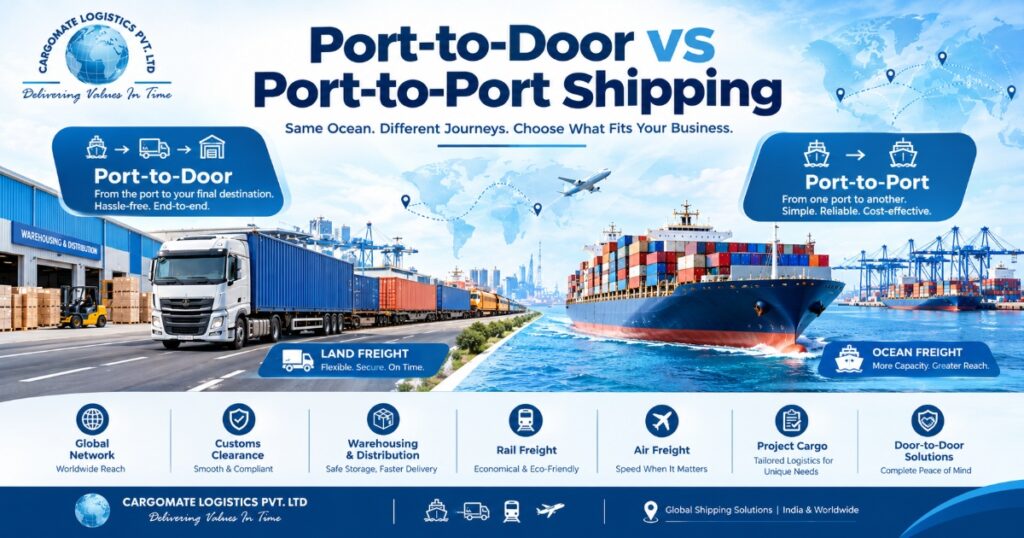
Port-to-Door shipping extends the logistics service beyond the destination port toward the customer’s specified delivery location.
A simplified journey can look like:
Supplier → Origin Port → International Freight → Destination Port → Customs Clearance → Inland Transport → Final Address
Instead of arranging separate transportation after the cargo reaches the destination port, the shipment can be coordinated through to the agreed delivery location.
For businesses without their own logistics network, this can make international cargo movement easier to manage.
Port-to-Door services may also be structured with different combinations of freight, customs, warehousing, and domestic transportation depending on the shipment.
Port-to-Door vs Port-to-Port: Key Difference
The simplest way to understand the difference is:
Port-to-Port = Port to Port
Port-to-Door = Port to Final Delivery Location
However, the actual scope should always be confirmed before booking because different freight providers can define service inclusions differently.
| Feature | Port-to-Port | Port-to-Door |
| International freight | ✓ | ✓ |
| Origin port handling | ✓ | ✓ |
| Destination port handling | ✓ | ✓ |
| Destination customs | May be separate | Can be included |
| Inland transportation | Usually separate | Can be included |
| Final delivery | Usually separate | ✓ |
| Logistics coordination | More buyer-managed | More provider-managed |
| Convenience | Lower | Higher |
| Best suited for | Businesses with logistics capability | Businesses wanting end-to-end coordination |
How Does Port-to-Port Shipping Work?
A typical Port-to-Port shipment follows several stages.
1. Cargo Preparation
The supplier prepares the goods, commercial invoice, packing list, and other required documents.
2. Transportation to Origin Port
Cargo is moved from the supplier’s premises to the export port.
3. Export Clearance
The shipment completes applicable export procedures.
4. International Freight
Cargo travels by ocean freight or another agreed transportation method.
5. Arrival at Destination Port
The shipment reaches the destination port.
6. Destination Handling
The buyer or appointed logistics provider arranges applicable destination procedures.
7. Customs and Inland Delivery
If not included in the original service, customs clearance, port handling, duties/taxes, and transportation to the final destination are arranged separately.
This model can provide flexibility but requires the buyer to coordinate more parts of the logistics chain.
How Does Port-to-Door Shipping Work?
Port-to-Door shipping adds the transportation and coordination required to reach the final destination.
A typical process includes:
Step 1: Supplier Coordination
Cargo details, pickup location, product information, weight, dimensions, and documentation are collected.
Step 2: Origin Transportation
The cargo is moved to the origin port.
Step 3: Export Clearance
Required export procedures are completed.
Step 4: International Freight
The shipment is transported to the destination country.
Step 5: Destination Customs
The required import clearance procedures are completed according to the shipment and applicable regulations.
Step 6: Inland Transportation
The cargo is moved from the destination port toward the agreed delivery location.
Step 7: Final Delivery
The shipment reaches the customer’s warehouse, office, factory, or other specified destination.
Which Is More Cost-Effective: Port-to-Port or Port-to-Door?
There is no universal answer.
Port-to-Port shipping may appear cheaper because the quoted freight service covers a more limited portion of the logistics journey. However, the buyer may then need to pay separately for customs clearance, port handling, inland transportation, and final delivery.
Port-to-Door shipping may have a higher quoted price, but more logistics services can be bundled into the overall arrangement.
Therefore, businesses should compare the total landed logistics cost, not just the international freight rate.
When comparing quotations, check:
- Ocean or air freight
- Origin charges
- Destination charges
- Customs clearance
- Duties and taxes
- Port handling
- Documentation
- Inland transportation
- Final-mile delivery
- Warehousing
- Additional handling charges
When Should You Choose Port-to-Port Shipping?
Port-to-Port can be suitable when your business already has logistics resources at the destination.
For example, you may choose Port-to-Port if you:
- Have your own customs broker
- Have a dedicated transport provider
- Operate your own warehouse
- Regularly import large cargo volumes
- Have logistics staff managing shipments
- Want more control over individual logistics stages
It can also be useful for businesses that already have established supply-chain operations in both countries.
When Should You Choose Port-to-Door Shipping?
Port-to-Door can be useful when you want greater coordination from the international freight stage through final delivery.
It may suit:
- Small and medium-sized businesses
- E-commerce companies
- New importers
- Manufacturers
- Retailers
- Businesses importing from China
- Companies without their own transport network
- Businesses looking for simplified logistics coordination
For these businesses, having one logistics provider coordinate multiple stages can reduce the administrative burden of managing separate vendors.
Port-to-Door Shipping from China to India
China-to-India shipping is a major requirement for businesses sourcing products and materials internationally.
A Port-to-Door shipment can be structured around a journey such as:
China Supplier → Chinese Port → Sea Freight → Indian Port → Customs Clearance → Inland Transportation → Indian Delivery Address
The appropriate route and service depend on factors such as:
- Product type
- Shipment size
- Cargo weight
- Origin location
- Destination city
- Required delivery time
- Customs requirements
- Freight mode
For larger shipments, FCL or LCL sea freight may be considered. For urgent or smaller cargo, air freight may be more appropriate.
Planning China-to-India Cargo?
CargoMate Logistics can help coordinate international freight, customs clearance, and inland logistics according to your shipment requirements.
Port-to-Port vs Port-to-Door for Importers
For importers, the main consideration is often how much logistics responsibility they want to manage themselves.
With Port-to-Port, the importer may need to coordinate several destination-side services.
With Port-to-Door, more of these activities can be coordinated as part of the overall shipping arrangement.
This doesn’t mean Port-to-Door is automatically the right option. Businesses should consider their internal logistics capability, shipment volume, budget, delivery requirements, and desired level of control.
Important Documents for International Shipping
Regardless of the shipping model, documentation is an important part of international cargo movement.
Depending on the shipment, documents may include:
- Commercial Invoice
- Packing List
- Bill of Lading
- Air Waybill
- Certificate of Origin
- Bill of Entry
- Insurance documents
- Import/export documentation
- Product-specific certificates or licences
Requirements vary according to the cargo, country, product classification, and applicable regulations.
Incorrect or incomplete documentation can contribute to customs delays, so businesses should review documentation before shipment.
Common Mistakes When Comparing Shipping Services
Comparing Only Freight Rates
A lower international freight rate does not necessarily mean a lower total logistics cost.
Ignoring Destination Charges
Port handling, documentation, customs, and transportation can add significant costs.
Not Checking the Delivery Scope
Ask whether the quotation ends at the port or includes final delivery.
Assuming Customs Is Included
Always confirm who is responsible for import customs clearance and related charges.
Not Checking the Incoterm
Terms such as FOB, CIF, DAP, and DDP allocate responsibilities differently.
Not Confirming the Final Address
A Port-to-Door quotation should clearly identify the agreed delivery location.
How to Choose Between Port-to-Port and Port-to-Door
Ask these five questions:
1. Do we have our own customs and transport arrangements?
If yes, Port-to-Port may provide useful flexibility.
2. Do we want one provider to coordinate more of the shipment?
If yes, Port-to-Door may be more convenient.
3. What is the complete landed cost?
Compare all charges rather than the headline freight price.
4. How much control do we need?
Port-to-Port can give businesses greater control over destination-side arrangements.
5. Where does our logistics responsibility end?
Clearly define whether the shipment ends at the port, warehouse, factory, office, or another location.
Frequently Asked Questions
What is the difference between Port-to-Port and Port-to-Door shipping?
Port-to-Port generally covers transportation between two ports, while Port-to-Door extends the service toward the customer’s specified final delivery location.
Is Port-to-Door more expensive than Port-to-Port?
The quoted price can be higher because additional services may be included. However, the best comparison is the total cost after adding destination handling, customs, inland transportation, and delivery charges.
Which is better for small businesses?
Port-to-Door can be convenient for businesses that do not have their own customs, transportation, or logistics teams. The appropriate option depends on the company’s requirements.
Does Port-to-Door include customs clearance?
It can, but businesses should confirm the exact quotation and service scope before booking.
Can I use Port-to-Door shipping from China to India?
Yes. Port-to-Door logistics can be arranged for China-to-India cargo, subject to the shipment, route, product, customs, and delivery requirements.
Is Port-to-Port shipping cheaper?
The initial freight quotation may be lower because fewer services are included. However, additional destination charges can increase the final logistics cost.
Final Takeaway
The difference between Port-to-Port and Port-to-Door shipping comes down to the level of logistics responsibility and delivery coverage.
Port-to-Port:
Best suited to businesses that can manage destination-side logistics independently.
Port-to-Door:
Useful for businesses looking for greater coordination through to the final delivery location.
Before selecting a service, compare the complete logistics cost, customs responsibilities, documentation, destination charges, transportation, delivery scope, and Incoterm.
For businesses importing or exporting internationally, the right logistics structure can make shipment management more predictable and efficient.
Move Your Cargo Beyond the Port with CargoMate Logistics
Looking for Port-to-Door, Port-to-Port, air freight, sea freight, customs clearance, or international freight forwarding services?
CargoMate Logistics can help coordinate your cargo movement from international origin to the required destination.
Get in touch with CargoMate Logistics for a shipment-specific freight solution.
CargoMate Logistics — International Freight. Customs. Door-to-Door Logistics.