India–Middle East Trade Corridors: The New Logistics Opportunity for Indian Exporters
India’s relationship with the Middle East is entering a new phase. The region is no longer just an important destination for Indian goods—it is becoming a strategic trade, logistics, warehousing and re-export hub connecting Indian businesses with markets across the Gulf, Africa and Europe.
With expanding ports, free zones, multimodal connectivity, digital trade systems and growing demand for Indian products, India Middle East trade can offer Indian exporters new routes to international markets.
For businesses planning expansion in 2026 and beyond, understanding these emerging trade corridors can be as important as finding the right overseas buyer.
CargoMate Logistics helps Indian exporters manage the practical side of international trade through DGFT consultancy, customs clearance, freight forwarding, export documentation and end-to-end EXIM logistics support.
Why the Middle East Matters for Indian Exporters
The Middle East occupies a strategically important position between Asia, Europe and Africa.
Countries such as the UAE, Saudi Arabia, Oman and Qatar have invested heavily in ports, airports, logistics parks, free zones and distribution infrastructure. This has created opportunities for businesses that want to use the region not only as an end market but also as a gateway to other countries.
For Indian exporters, the opportunity can be viewed through three different models:
India → Middle East → Final Customer
India → Middle East → Re-export Market
India → Middle East Distribution Hub → Africa/Europe/Global Markets
This makes the region particularly interesting for Indian manufacturers and MSMEs looking to scale beyond traditional export destinations.
5 Emerging India–Middle East Trade Opportunities
1. India–UAE: A Major Gateway for Global Distribution
The UAE has become one of the most important commercial and logistics centres in the region.
Its strategic location, established port infrastructure, free zones and extensive air-cargo network make it attractive for Indian companies looking for regional distribution.
Indian exporters can potentially use the UAE for:
- Consumer goods
- Engineering products
- Electronics
- Textiles
- Food products
- Pharmaceuticals
- Auto components
- Machinery
- Chemicals
A business does not necessarily have to sell only to UAE customers. A UAE-based distribution operation can potentially support sales into other Gulf and international markets, subject to the applicable customs, origin and regulatory rules.
2. India–Saudi Arabia: A Growing Manufacturing & Infrastructure Opportunity
Saudi Arabia’s economic diversification programmes are creating demand beyond oil and energy.
Large investments in infrastructure, manufacturing, construction, tourism, logistics and technology are opening opportunities for international suppliers.
Indian companies operating in areas such as:
- Engineering
- Construction materials
- Electrical equipment
- Machinery
- Food processing
- Pharmaceuticals
- Industrial products
can explore Saudi Arabia as an increasingly important market.
However, exporters should not treat Saudi shipments as simple point-to-point freight movements. Product standards, documentation, customs requirements and buyer-side compliance need to be considered before shipment.
3. India–Oman: Strategic Potential for Multimodal Trade
Oman has an important geographical advantage because of its position outside the Strait of Hormuz and its access to the Arabian Sea.
Its ports and logistics infrastructure can support connections between the Indian subcontinent, Gulf markets and wider international trade routes.
For Indian exporters, Oman can become particularly interesting for businesses looking at:
- Industrial products
- Minerals
- Engineering goods
- Food products
- Machinery
- Building materials
- Project cargo
The growing importance of multimodal logistics means exporters should evaluate the entire route—not simply the ocean freight component.
4. India–Qatar & the Wider Gulf Market
Qatar and other Gulf markets provide opportunities for Indian exporters in sectors ranging from food and consumer products to engineering and specialised industrial goods.
Demand from Gulf markets can be particularly attractive for Indian MSMEs because geographical proximity can provide relatively efficient access compared with more distant markets.
But exporters should evaluate:
Product demand + regulatory requirements + landed cost + freight + customs + local distribution
rather than looking only at the selling price.
The Biggest Opportunity: Middle East as a Re-Export Hub
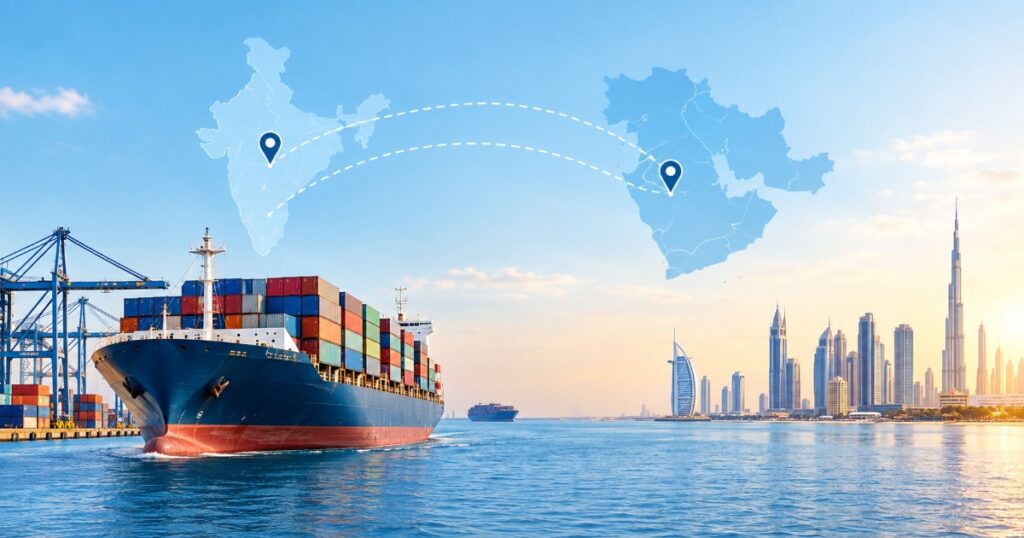
One of the most interesting opportunities is the use of the Middle East as a regional distribution platform.
Consider a simplified model:
Indian Manufacturer
↓
Export Documentation & Customs
↓
Sea/Air Freight
↓
Middle East Distribution Hub
↓
Regional Warehouse
↓
GCC / Africa / Other Markets
This model can potentially help businesses reduce delivery times to regional customers and maintain inventory closer to buyers.
However, exporters must carefully examine country-of-origin rules, customs procedures, duties, re-export requirements and tax implications before implementing such a structure.
Which Indian Products Could Benefit?
Several Indian product categories are well-positioned to explore Middle Eastern markets.
| Product Category | Potential Opportunity |
| Engineering Goods | Infrastructure & industrial demand |
| Pharmaceuticals | Healthcare and medical supply |
| Food & Spices | Large consumer and diaspora markets |
| Textiles | Apparel, home textiles & fabrics |
| Auto Components | Automotive aftermarket & manufacturing |
| Electronics | Growing technology ecosystem |
| Chemicals | Industrial applications |
| Machinery | Construction & manufacturing |
| Building Materials | Infrastructure development |
| Renewable Energy Equipment | Energy-transition projects |
The right opportunity depends on the destination market, product classification, buyer requirements and applicable regulations.
Logistics Is the Real Competitive Advantage
A competitive product alone does not guarantee export success.
Indian exporters also need to control:
Freight Cost
Shipping costs can significantly affect landed price, particularly for bulky or lower-margin products.
Transit Time
Faster delivery can become a major advantage when competing with suppliers from other Asian markets.
Customs Clearance
Incorrect documentation, classification or valuation issues can create delays and unexpected costs.
Cargo Handling
Fragile, temperature-sensitive, oversized or hazardous cargo requires specialised logistics planning.
Last-Mile Distribution
Reaching the buyer’s warehouse efficiently is just as important as getting cargo to the destination port.
This is why exporters should design their logistics strategy before accepting large international orders.
DGFT & Customs Compliance Cannot Be Ignored
Entering a new Middle Eastern market also means understanding India’s export-side requirements.
Before shipping, businesses should check:
- IEC validity
- Correct ITC(HS) classification
- Export policy
- Restricted/prohibited goods conditions
- Required authorisations
- Certificate of Origin requirements
- Commercial invoice
- Packing list
- Shipping documentation
- Product-specific certificates
- Destination-country requirements
A product may be commercially attractive but still face complications if its classification or documentation is incorrect.
CargoMate Logistics supports exporters with DGFT consultancy, customs clearance, export documentation, freight forwarding and broader EXIM compliance, helping businesses reduce avoidable shipment risks while entering international markets.
Sea Freight vs Air Freight for Middle East Exports
Choosing the correct mode can have a direct impact on profitability.
Sea Freight
Best suited for:
- Bulk cargo
- Machinery
- Industrial goods
- Large consignments
- Cost-sensitive shipments
Air Freight
More suitable for:
- Urgent shipments
- High-value products
- Samples
- Smaller consignments
- Time-sensitive goods
Multimodal Logistics
For larger businesses, combining multiple transport modes can provide a balance between cost, speed and flexibility.
The correct choice depends on shipment size, product type, destination, urgency and buyer requirements.
How Indian Exporters Can Prepare for the Middle East Opportunity
Before entering a new Middle Eastern market, exporters should follow a structured approach.
Step 1: Identify the Right Market
Do not treat the Middle East as a single market. UAE, Saudi Arabia, Oman, Qatar and other countries have different commercial and regulatory environments.
Step 2: Validate Product Demand
Identify products with genuine demand rather than selecting a market simply because it is geographically close.
Step 3: Check Export Policy
Verify the applicable DGFT policy and ITC(HS) classification before confirming the transaction.
Step 4: Calculate Landed Cost
Include product cost, freight, insurance, customs duties, port charges, handling and other applicable costs.
Step 5: Select the Right Logistics Model
Decide between direct shipment, consolidated cargo, air freight, sea freight or a regional distribution model.
Step 6: Build a Compliance Checklist
Prepare documentation and destination-specific requirements before the cargo is dispatched.
Step 7: Work With an Experienced EXIM Partner
Professional logistics and compliance support can help reduce documentation errors, clearance delays and unexpected costs.
Why 2026 Could Be an Important Year
The Middle East is increasingly developing from a traditional import market into a logistics and redistribution ecosystem.
At the same time, Indian manufacturers are looking for new markets as global supply chains become more diversified.
This creates an interesting combination:
Indian Manufacturing Growth
Middle East Logistics Infrastructure
Growing Regional Demand
India’s Expanding Export Ecosystem
=
New Opportunities for Indian Exporters
Businesses that understand this shift early may be better positioned to establish regional customers and distribution networks.
Final Takeaway
The India–Middle East trade relationship is evolving beyond conventional exports.
The next opportunity may not simply be selling to a Middle Eastern customer. It could involve using the region as a strategic logistics platform connecting Indian manufacturers with customers across the Gulf, Africa and other international markets.
But successful expansion requires more than finding a buyer. Exporters need the right DGFT compliance, HS classification, customs documentation, freight strategy, destination-market checks and delivery model.
For Indian manufacturers, traders and MSMEs planning to expand into the Middle East, CargoMate Logistics can provide integrated support across DGFT consultancy, customs clearance, freight forwarding and EXIM logistics.
Planning Your Next Middle East Export?
Talk to CargoMate Logistics before your shipment moves. Get professional support for export documentation, DGFT compliance, customs clearance and international freight planning.