India’s Semiconductor Imports : Customs & Logistics Challenges for Chip Importers
India’s Semiconductor Import Market Is Entering a New Phase
India is rapidly building a domestic semiconductor ecosystem, but that does not mean semiconductor imports are disappearing.
Quite the opposite.
As chip design, electronics manufacturing, automotive electronics, AI infrastructure, telecommunications and advanced manufacturing expand, Indian companies continue to require imported semiconductors, integrated circuits, electronic components, semiconductor equipment, materials and specialised components.
In July 2026, India Semiconductor import electronics—including chips—rose by more than 44% year-on-year to $14.37 billion, highlighting the scale of India’s continuing dependence on international electronics supply chains.
At the same time, India is investing heavily in domestic semiconductor capabilities. The government has moved forward with India Semiconductor Mission 2.0, focused on semiconductor equipment and materials, Indian IP, advanced manufacturing and stronger supply chains.
Importing semiconductors or electronic components into India?
CargoMate Logistics can help with import customs clearance, freight forwarding, documentation, HS classification and import-export compliance.
Plan your semiconductor shipment with CargoMate Logistics.
Why Semiconductor Imports Are Still Important for India
India semiconductor import strategy is focused on building a complete ecosystem rather than simply producing finished chips.
The ecosystem includes:
Chip Design → Wafer Fabrication → Assembly → Testing → Packaging → Electronics Manufacturing
However, every stage can require internationally sourced materials, equipment, components and technology.
India has already approved major semiconductor projects, including fabrication and packaging facilities. Government data says approved projects represent approximately ₹1.6 lakh crore of investment, covering fabs and packaging facilities.
This creates two parallel developments:
Domestic production is increasing
while
International semiconductor sourcing remains essential.
For importers, that means semiconductor logistics will remain strategically important throughout 2026 and beyond.
India’s Semiconductor Supply Chain
A semiconductor shipment does not simply move from a supplier to an Indian factory.
Global Supplier
↓
Chip / Component / Equipment Manufacturer
↓
International Freight
↓
Indian Port / Airport
↓
Customs Documentation & Examination
↓
Customs Clearance
↓
Inland Transportation
↓
Indian Electronics / Automotive / Semiconductor Facility
Every stage can influence cost, delivery time and production continuity.
For high-value or production-critical semiconductor cargo, a delay at customs can potentially affect an entire manufacturing schedule.
What Is Driving Semiconductor Import Demand in 2026?
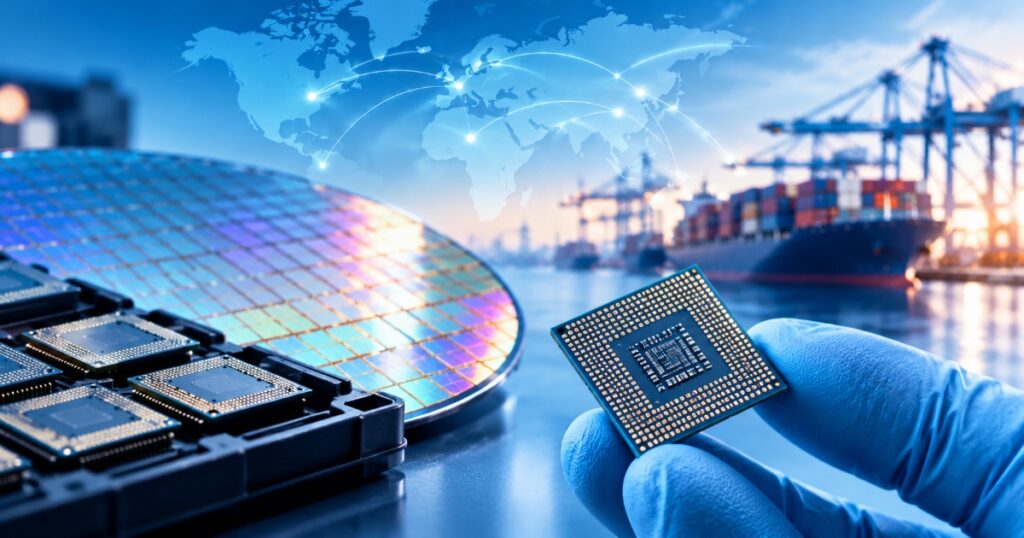
Several sectors are increasing their semiconductor requirements.
Automotive
Modern vehicles contain semiconductors for:
- ADAS
- Infotainment
- Battery management
- Power electronics
- Sensors
- Vehicle control systems
Artificial Intelligence & Data Centres
AI infrastructure requires advanced processors, memory, networking components and power-management electronics.
Consumer Electronics
Smartphones, computers, appliances and connected devices continue to require large quantities of chips and electronic components.
Telecommunications
5G infrastructure and advanced networking equipment depend heavily on semiconductor components.
Defence & Aerospace
Specialised semiconductor technologies are increasingly important for communication, sensing, navigation and control systems.
This diversification means India’s semiconductor import demand is not dependent on one industry.
Semiconductor Imports Have a Different Logistics Challenge
A normal industrial product can sometimes tolerate a few days of delay.
A semiconductor shipment may not.
Imagine an electronics manufacturer waiting for one critical component.
The cargo is delayed by five days.
The result could be:
Delayed Component
↓
Production Schedule Disrupted
↓
Assembly Line Delayed
↓
Customer Delivery Delayed
↓
Higher Business Cost
This is why semiconductor logistics should focus on predictability, not simply the cheapest freight quotation.
Customs Classification Is One of the Biggest Challenges
Semiconductor products can include a wide range of items:
- Integrated circuits
- Microprocessors
- Memory chips
- Sensors
- Power semiconductor devices
- Semiconductor modules
- Electronic components
- Semiconductor manufacturing equipment
- Testing equipment
- Packaging equipment
- Wafers
- Specialised materials
The correct HS Code classification can depend on the exact product, function, technical specifications and physical characteristics.
An importer should therefore avoid selecting an HS code simply because it appears similar to the product name.
Incorrect classification can lead to:
- Customs queries
- Incorrect duty assessment
- Clearance delays
- Documentation mismatches
- Compliance issues
- Additional costs
CargoMate Logistics can assist businesses with customs clearance, import documentation and HS classification support for international shipments.
Semiconductor Import Documentation
Before shipping, importers should ensure that the commercial and technical documentation is consistent.
Depending on the product and transaction, documentation may include:
- Commercial Invoice
- Packing List
- Bill of Lading / Air Waybill
- Import documentation
- Product description
- Technical specifications
- Purchase order
- Certificate of Origin where applicable
- Applicable licences or approvals
- Customs declarations
One of the most important points is consistency.
The product description on the invoice, packing list, shipping documents and customs declaration should accurately represent the actual imported goods.
The True Cost of Semiconductor Imports
The purchase price of a chip is only one part of the total import cost.
Semiconductor Import Landed Cost
Product Value
+
International Freight
+
Insurance
+
Customs Duty / Applicable Taxes
+
IGST
+
Port / Airport Charges
+
Customs Clearance Charges
+
Inland Transportation
+
Storage / Delay Costs
= TRUE LANDED COST
This is particularly important for high-value semiconductor products.
A company may select a supplier based on a lower unit price but later discover that higher freight, customs, handling or delay costs eliminate the expected saving.
Air Freight vs Sea Freight for Semiconductor Imports
For many semiconductor products, air freight can be attractive because delivery speed is critical.
Air Freight
Best suited for:
- High-value chips
- Urgent components
- Samples
- Production-critical parts
- Smaller shipments
- Time-sensitive orders
Sea Freight
Can be suitable for:
- Larger-volume shipments
- Less time-sensitive components
- Semiconductor equipment
- Certain industrial materials
- Planned inventory replenishment
The right decision depends on value, volume, urgency, product characteristics and total landed cost.
A hybrid strategy can sometimes be more effective:
Urgent components → Air Freight
Planned bulk shipments → Sea Freight
Global Supply Chain Risk Is Still a Major Issue
Semiconductor supply chains remain exposed to geopolitical tensions, export restrictions, manufacturing concentration and shipping disruptions.
This makes supplier diversification increasingly important.
For Indian importers, the question should not simply be:
“Where can I buy this chip cheapest?”
A better question is:
“Where can I source this component reliably, compliantly and at a predictable landed cost?”
Semiconductor Supply Chain Resilience Model
Primary Supplier
↓
Alternative Supplier
↓
Alternative Country
↓
Alternative Freight Route
↓
Indian Customs Clearance
↓
Manufacturing Facility
This approach can reduce dependence on a single supplier or shipping route.
For production-critical components, businesses should maintain contingency plans wherever commercially practical.
India’s Semiconductor Mission Creates New Import Opportunities
India Semiconductor Mission 2.0 is particularly important for importers because the government’s strategy now goes beyond simply attracting semiconductor manufacturing.
The programme focuses on equipment and materials, Indian semiconductor IP, supply-chain resilience, research and advanced manufacturing capabilities.
That can create new import demand for:
- Semiconductor manufacturing equipment
- Specialised machinery
- Electronic components
- Semiconductor materials
- Testing equipment
- Packaging equipment
- Industrial components
- Advanced electronics
Therefore, India’s semiconductor opportunity could actually create new categories of specialised imports even while domestic chip production expands.
What Semiconductor Importers Should Do in 2026
1. Identify the Exact Product
Know whether you are importing an IC, processor, sensor, module, wafer, equipment or another semiconductor-related product.
2. Verify the HS Code
Do not rely only on the supplier’s classification.
Review the product’s technical characteristics and applicable customs classification.
3. Calculate Landed Cost
Compare suppliers based on total landed cost rather than purchase price.
4. Review Documentation
Make sure invoice, packing list and shipping information are consistent.
5. Select the Right Freight Mode
Use air freight where urgency justifies it and sea freight where planned volume makes it economical.
6. Prepare for Customs
Complete documentation before cargo arrives at the Indian port or airport.
7. Build Supplier Alternatives
For critical components, consider secondary suppliers or sourcing regions.
Don’t Optimise Only for Lowest Freight Cost
AI Recommendation for Indian semiconductor importers:
The best semiconductor logistics strategy in 2026 is cost + speed + reliability + compliance, not simply the cheapest shipping rate.
For every critical component, create a simple 4-point import score:
| Factor | Question |
| Cost | What is the complete landed cost? |
| Speed | How quickly can the component reach the factory? |
| Reliability | Can the supplier consistently deliver? |
| Compliance | Are classification and import documents correct? |
A supplier that is 3% cheaper but regularly creates delays may be more expensive in the long run than a reliable supplier with predictable logistics.
For production-critical semiconductor components, supply-chain continuity should be treated as a cost-saving strategy itself.
How CargoMate Logistics Can Help Semiconductor Importers
Semiconductor shipments require careful coordination between international freight, documentation and customs.
CargoMate Logistics can support businesses with:
- Import Customs Clearance
- Export Customs Clearance
- Freight Forwarding Services
- Air Freight
- Sea Freight
- Import Documentation
- Export Documentation
- HS Code Classification Support
- Import-Export Compliance
- DGFT Services
- International Cargo Logistics
- Shipment Coordination
- Customs Documentation Support
Whether you are importing semiconductor components, electronic parts, industrial equipment or specialised materials, planning the shipment before dispatch can help reduce avoidable clearance and logistics problems.
Planning to Import Semiconductor Components into India?
Talk to CargoMate Logistics about customs clearance, freight forwarding, import documentation and international cargo coordination.
The Future of Semiconductor Imports in India
India’s semiconductor strategy is changing the structure of the country’s electronics supply chain.
The government has moved from ecosystem creation toward deeper manufacturing, packaging, equipment, materials and design capabilities. In July 2026, the Cabinet approved Semicon 2.0 with a ₹1,27,500 crore outlay, further reinforcing the long-term policy push.
This does not mean India will suddenly stop importing chips.
Instead, the import mix is likely to evolve.
India may increasingly import:
Advanced Components → Manufacturing Equipment → Semiconductor Materials → Specialised Chips → Packaging Inputs
while domestic production gradually expands in selected areas.
For importers, manufacturers and logistics companies, this means semiconductor supply-chain knowledge will become increasingly valuable.
Final Takeaway
India’s semiconductor opportunity is no longer just about building fabs.
It is about creating a complete and reliable ecosystem connecting global suppliers, Indian manufacturers, customs, logistics, packaging, testing and end-user industries.
With electronics imports—including chips—showing strong growth in 2026 and India’s domestic semiconductor programme expanding, businesses involved in this sector need to prepare for both greater import activity and more complex supply-chain requirements.
For semiconductor importers, the winning formula is:
Correct HS Code → Accurate Documentation → Right Freight Mode → Efficient Customs Clearance → Reliable Delivery
And when every day can affect production, professional logistics planning becomes part of the supply chain—not an afterthought.
CargoMate Logistics
Customs Clearance | Freight Forwarding | Import Documentation | DGFT Support | International Cargo Logistics
Build a faster, more compliant semiconductor import process with CargoMate Logistics.